Top 5 Marketing Priorities in 2026: Expert Insights + Trends That Will Shape Budgets

After years of focusing on tools and channels, companies are returning to basics: trust in brands, clear business value, and real impact on growth. AI changes how people discover brands, privacy limits tracking, and CFO pressure makes “good enough” marketing performance harder to justify.
To understand what will shape strategy and budget allocation in 2026, we asked marketers and leaders what they’re prioritizing—and what they’re cutting. Combining their perspectives with broader trend signals, we’ve mapped marketing priorities with implementation considerations.
Key Takeaways
- AI is becoming infrastructure, not an experiment. Winning teams fund workflows, governance, and measurable outcomes—not isolated pilots.
- One-to-one personalization is back—powered by first-party data. CMOs are prioritizing end-to-end customer experience across the entire journey, not just acquisition.
- Marketing budgets are clustering around three themes: brand building, provable AI ROI, and first-party data—while high-quality CX (Customer Experience) is rising to the top again.
- “Effectiveness over volume” is the new default. Economic uncertainty is pushing for stricter measurement, clearer attribution logic, and tougher decisions about what to scale (and what to stop).
#1 AI and Automation (Umbrella Trend)
What it is in 2026
AI is no longer “just content generation.” In 2026, it functions as marketing infrastructure: accelerating audience research, creative iteration, lifecycle messaging, campaign optimization, and support/ops—while also introducing a new layer of AI governance (brand safety, legal, disclosure, hallucinations, and IP risk).
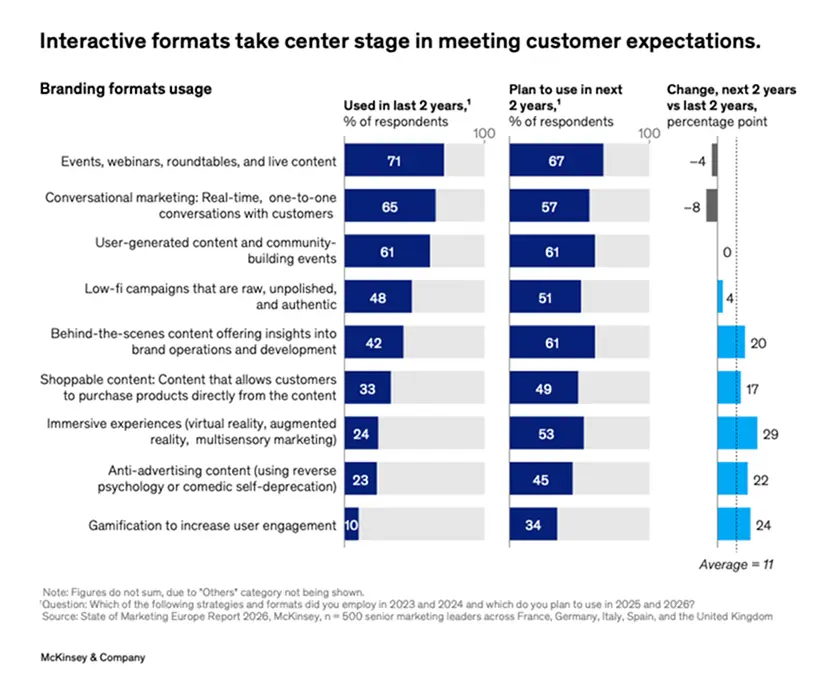
In the State of Marketing Europe 2026 study, McKinsey surveyed 500 marketing leaders across five European countries and identified three key directions shaping the 2026 agenda: trust, effectiveness, and the use of generative AI. 68% of global CMOs name AI as the #1 marketing priority for 2026—higher than any other focus area.
Why it matters for digital marketing budgets
AI spend is shifting from discretionary pilots to baseline operating cost—and that changes budgeting in these ways:
What to fund in 2026: where digital marketing spending goes
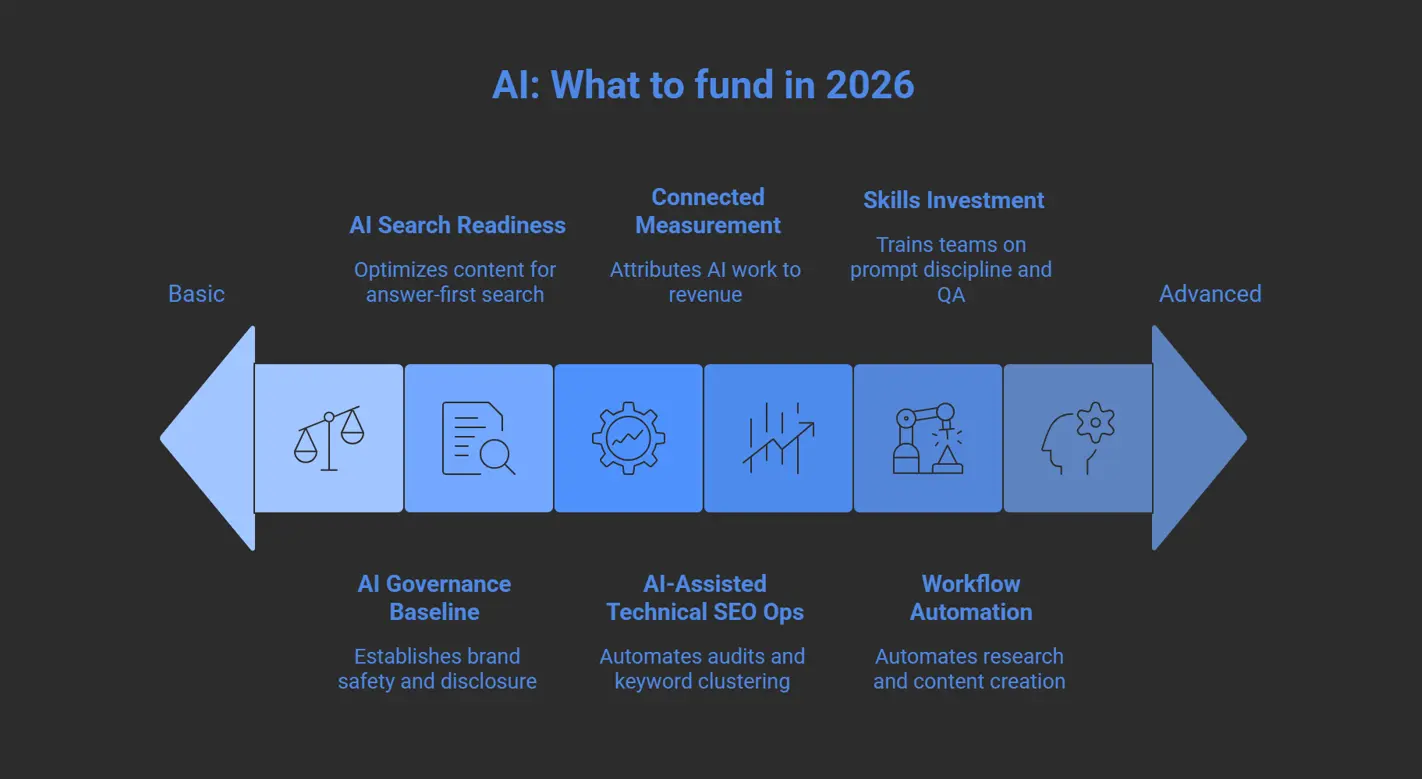
- AI governance baseline. Brand safety rules, disclosure policy, approval workflow, “human-in-the-loop” review for high-risk outputs.
- Workflow automation. AI-assisted research briefs, content outlines, creative variants, reporting summaries—measured by time saved + throughput.
- AI search readiness (starter kit). Update content to be answer-first, add basic schema where relevant, strengthen author/brand credibility signals on key pages.
- Connected measurement. Define how AI-enabled work is attributed (incrementality tests, blended attribution logic, channel-level KPIs that tie to revenue).
- AI-assisted technical SEO Ops. Automate recurring audits, keyword clustering, internal linking suggestions, and reporting—while reserving expert time for strategy, prioritization, and quality control.
- Skills investment. Train teams on prompt discipline, QA processes, evaluation rubrics, and brand-safe AI usage—because uncontrolled automation becomes a trust risk.
Automation helps—but unchecked AI can damage trust, so keep expert oversight in the loop.
Expert quote
AI visibility used to get less focus because we didn’t have tools to analyze it. Now we do—and the work is moving fast.

In the second half of 2025, the picture changed significantly — the role of AI, LLM platforms, and new user touchpoints became much bigger.

#2 Distribution Across Organic and Paid Channels
What it is in 2026
Distribution is now more important than ever. In the latest Q&A, OpenAI CEO Sam Altman said that as creating products becomes easier, distribution and user attention are the main constraints.
Audiences discover brands across multiple surfaces—classic search, AI answers, social, video, creators, and communities—while paid reach and platform algorithms stay volatile. The priority in 2026 is building a resilient growth engine that pairs:
- Strong organic fundamentals (technical performance, content architecture, credibility signals, brand trust)
- Paid ad performance (creative testing, audience strategy, marginal ROI)
- Lifecycle conversion (email/nurture/retention loops that turn traffic into revenue)
This is also where “classic SEO” expands into GEO: optimizing for visibility in AI assistants and AI-driven search through structured content, entity/brand signals, and high-quality proof assets (case studies, expert content, video).
Why it matters for digital marketing budgets
What to fund in 2026: where digital marketing spending goes
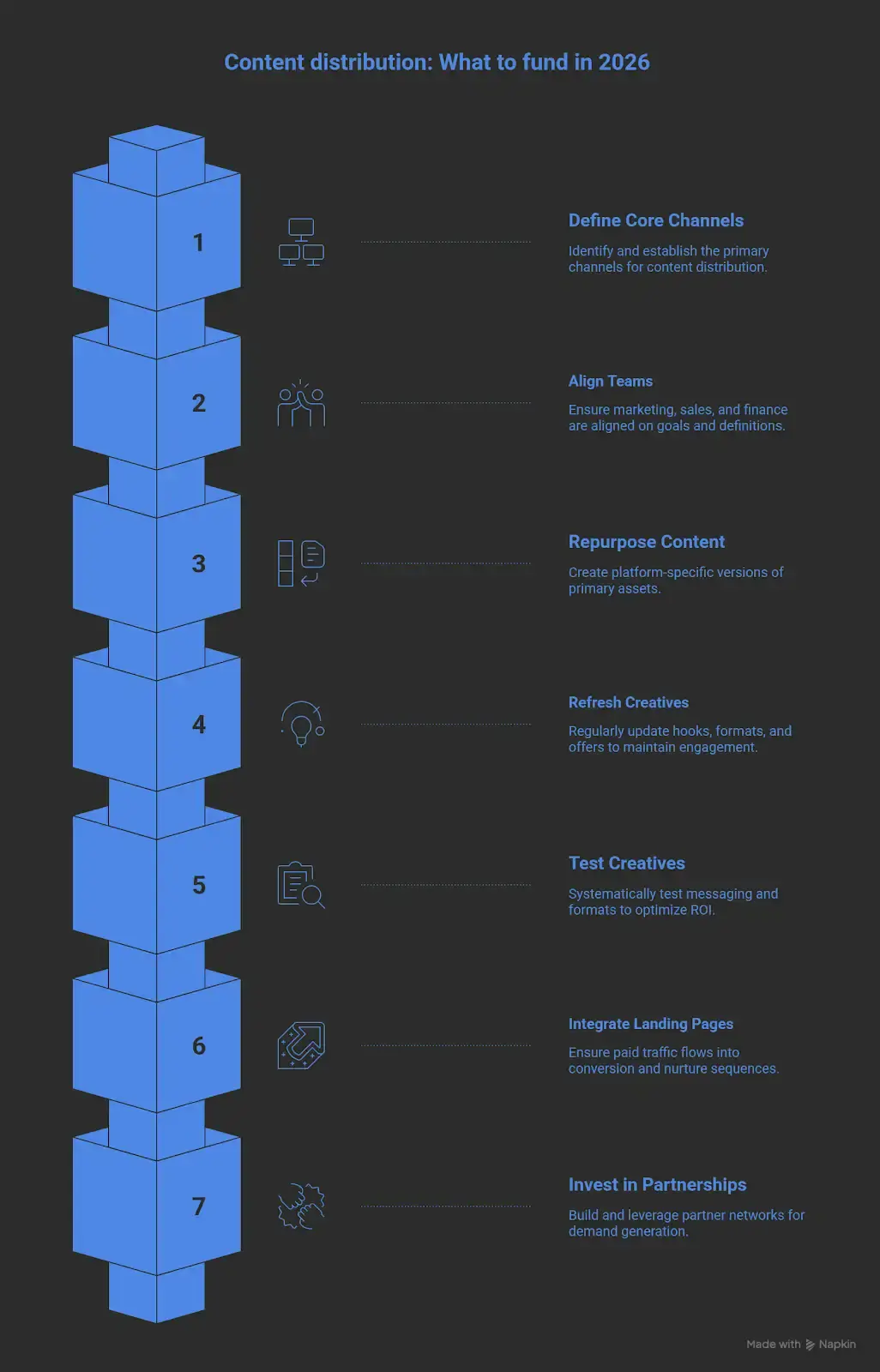
- Pick 3–5 core channels and define the role of each (demand capture vs demand creation vs retention).
- Align marketing, sales, finance on one set of outcomes (pipeline, revenue, retention), shared definitions, and a monthly “scale/hold/stop” cadence.
- Content repurposing system. Create 1 primary asset → produce platform-specific versions (YouTube, LinkedIn, short video, newsletter, community posts). Avoid identical cross-posting.
- Creative refresh rhythm. Prevent diminishing returns by refreshing hooks, formats, and offers on a schedule (e.g., monthly iterations + quarterly repositioning).
- Creative testing framework. Test messaging angles and formats systematically; scale only what improves marginal ROI (not just CTR).
- Landing lifecycle integration. Ensure paid traffic routes into conversion and nurture (email sequences, retargeting, onboarding), not dead-end pages.
- Invest in partner networks, referral programs, and co-marketing—especially if paid demand is volatile.
Expert quote
We’ve been working in an omnipresent marketing model for years—SEO is tightly integrated with PPC, branding, product, and other channels from planning to execution to analysis.
We work across content, website, partnerships, new product development, and market testing… The partnership channel performed best, while paid traffic performed worse due to a drop in demand.
#3 Conversion Optimization (CRO)
What it is in 2026
CRO in 2026 is no longer “landing page tweaks.” As traffic becomes more expensive and more fragmented (search + AI answers + social + video + creators + communities), growth increasingly comes from improving conversion, retention, and LTV—not just buying more clicks.
That means CRO expands across the full journey: pricing pages, onboarding, checkout, activation, lifecycle messaging, and retention loops—all tied to profitability, CAC payback, and funnel diagnostics.
Marketing spend in many companies approaches 8–9% of revenue, and in high-growth businesses exceeds 10%. At that scale, even 1–2% inefficiency becomes a meaningful financial loss.
Why it matters for digital marketing budgets
What to fund in 2026: where digital marketing spending goes
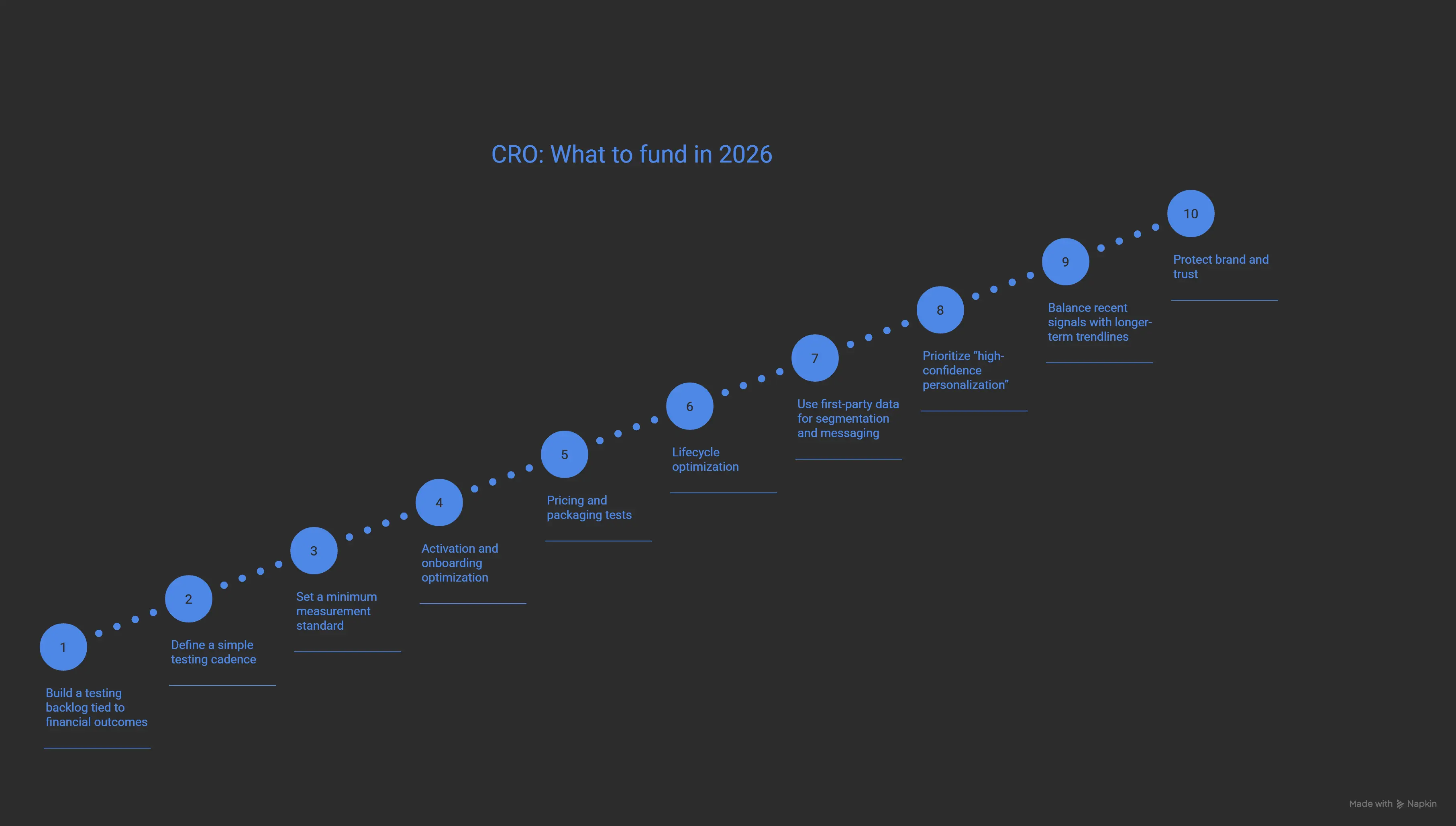
- Build a testing backlog tied to financial outcomes: CAC payback, conversion rate, LTV, retention— not just CTR.
- Define a simple testing cadence. Weekly experiments and monthly learnings review.
- Set a minimum measurement standard (sample size, test duration, primary metric).
- Activation and onboarding optimization (time-to-value, aha moments, friction removal).
- Pricing and packaging tests (plan clarity, proof, objection handling).
- Lifecycle optimization (email, in-app nudges, retargeting, churn prevention).
- Use first-party data for segmentation and personalized messaging—but keep it measurable and privacy-safe.
- Prioritize “high-confidence personalization” (e.g., by intent, industry, stage) over overly granular rules that are hard to maintain.
- Don’t let decisions be driven only by the last 2–4 weeks of performance. Balance recent signals with longer-term trendlines (seasonality, pipeline lag, cohort retention).
- Protect brand and trust, aggressive short-term conversion hacks can backfire in volatile markets.
Expert quote
In 2026, it’s less about scaling and more about adapting… The winners won’t be those who scale more, but those who adapt faster.
#4 Data Analytics and Attribution
What it is in 2026
Marketing measurement is shifting from “perfect user-level tracking” to decision-grade measurement. Privacy changes and signal loss are pushing teams toward first-party data, server-side tagging, privacy-safe matching, and modeled attribution.
Jentis: Server-side Tracking Report 2026
Adoption trends, industry signals, and strategic implications
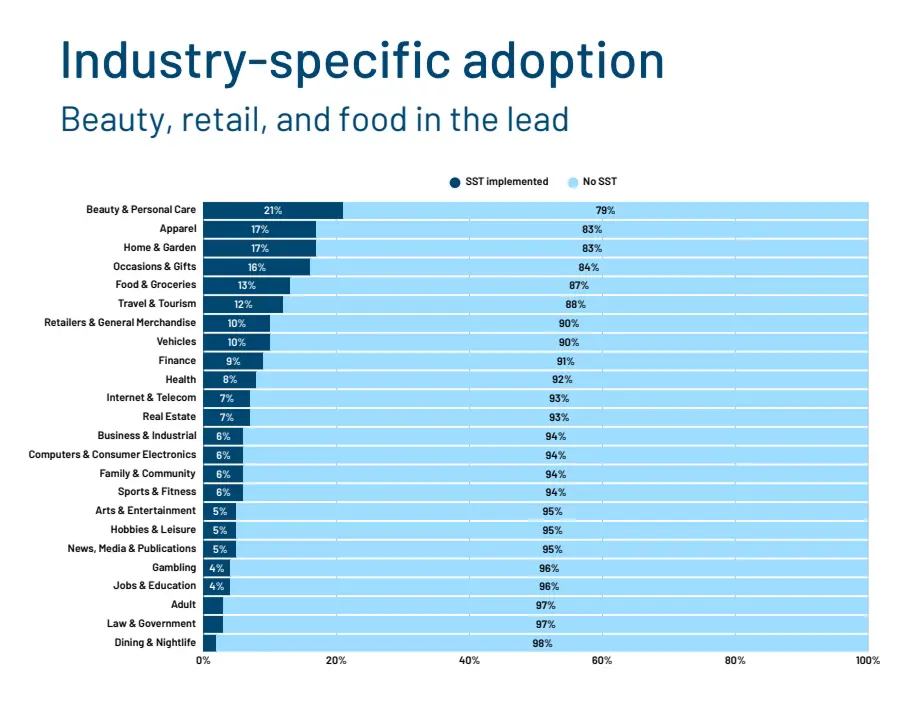
In practice, attribution in 2026 is less about one flawless source of truth—and more about a blended measurement system you can defend in budget conversations.
Why it matters for digital marketing budgets
What to fund in 2026: where digital marketing spending goes
- First-party data capture upgrades. Better email capture flows, value exchanges, preference centers, account creation incentives.
- Server-side tracking rollout. Server-side GTM (or equivalent), consent-mode alignment, event governance (naming, definitions, QA).
- CRM + website + product data connection. Minimum viable customer view so you can tie marketing touchpoints to pipeline/revenue/retention.
- Unified visibility monitoring. Track brand demand + organic visibility + paid efficiency + major discovery surfaces in one dashboard (even if it’s imperfect).
- Blended attribution approach, aligned to 1–2 exec-friendly KPIs. If a channel can’t show a plausible path to business impact, don’t scale it—fix measurement first.
- If market demands shift, stay close to customer insights and be ready to pivot quickly.
Expert quote
Less attention will go to channels and tactics that don’t have a transparent impact on business metrics, operate in isolation, or adapt poorly to changes in user behavior and AI.
#5 Community Building
What it is in 2026
Community in 2026 is an owned audience and trust engine—not a “nice-to-have” social tactic. As AI and automation touch more customer interactions, people become more sensitive to opaque practices, manipulation, and gaps between brand promises and real experience. A well-run community helps brands stay credible, human, and consistently present across a longer decision cycle.
Communities also act as a two-way system: you build relationships while continuously collecting customer insight, questions, objections, and product feedback.
Why it matters for digital marketing budgets
What to fund in 2026: where digital marketing spending goes
- Pick one primary hub: LinkedIn group, Slack/Discord, Telegram, Reddit, private forum, or events-led community.
- Seed UGC: templates, prompts, “member spotlights,” AMA sessions, expert roundups.
- Track recurring questions and objections → turn them into content briefs, landing page improvements, enablement, and product roadmap inputs.
- Create lightweight tagging for themes (pricing, integrations, use cases) so insights don’t get lost.
- Use advocacy and referral mechanics like an ambassador program: early access, co-marketing, speaking slots, partner perks. Make it easy to introduce peers and reward contributions (not just sign-ups).
- Don’t judge the community only by short-term leads. Track: retention, repeat engagement, assisted conversions, referrals, UGC volume, qualitative insight wins, and churn risk reduction.
Expert quote
UGC outperformed for us, while chasing ‘trend formats’—like LinkedIn video trends — underperformed. In 2026, we’ll focus on reactivating communities as social audiences become more passive, and we’ll deprioritize Facebook and X because they haven’t delivered results
Conclusion
Marketing priorities now center on measurement that works in an AI-search world, connected data stacks, and disciplined experimentation across creative and channel mix, so brand and performance operate as one integrated growth system, not competing functions.
Run a quick domain or keyword check
Start a 7-day trial
Discover More SEO Tools
Serp Crawling
Scrape Google SERP and analyze
Connector With Looker Studio
Connect to Looker Studio and create reports with data visualization
Bulk Keyword Analysis
Revolutionize your keyword research process with our bulk keyword checker
Keyword Difficulty Tool
Stay ahead of the competition and dominate your niche with our keywords difficulty tool
Recommended posts
Cases, life hacks, researches, and useful articles
Don’t you have time to follow the news? No worries! Our editor will choose articles that will definitely help you with your work. Join our cozy community :)
By clicking the button, you agree to our privacy policy.