Year in Search: AI Overview Study
What we learned from analyzing one billion keywords

Having your site selected by Google AI overviews (AIO) means you'll appear higher on SERPs than other organic pages. We analyzed 1 billion keywords and 35 million AI overviews (formerly Search Generative Experience, Google SGE). Analyzing our data, we looked at how AIO relates to content optimization. Here’s what we discovered.
TLDR:
- AIO share grew from 0.01% to 27.46% in one year. Biggest jump: March 2025 (+8%).
- AIO sources and organic top 20 are largely independent (~95% non-overlap)
- When AIO does use organic results, it heavily favors positions 1–5.
- UGC and authority sites dominate AIO citations.
- Google AI citations are quite volatile.
- US leads with 33.81% AIO rate.
- 70% of the AIO keywords have 10 or more words in them.
Introduction & Methodology
This research provides an analysis of the dynamics and characteristics of Google's AI Overviews based on data collected throughout 2025 (February — December). We focused on identifying key trends in AIO adoption, analyzing the source domains, examining the relationship between AIO and organic search rankings, and investigating the impact of query length.
An analysis based on a large sample of keywords identifies AIO occurrences and their associated organic sources using a multifaceted dataset (both Keyword research and Rank tracking Serpstat modules).
In order to create a clean dataset and additional insights into the correlation with AIO, we carefully removed SERP features results.
The key metrics include:
Key Findings: Google AI Summary Statistics
Dynamics of AIO Adoption
How common Google AI Overviews are overall? The monthly dynamics reveal a rapid expansion: we see the growth of AIO SERPs from 0.01% to 32% per year (Serpstat Rank Tracker data).
The real shift began in March 2025, when AIO presence jumped dramatically to 8.16%, signaling Google's aggressive rollout. By November 2025, AI Overviews appeared in 27.5% of tracked SERPs (Serpstat Keyword Research data).
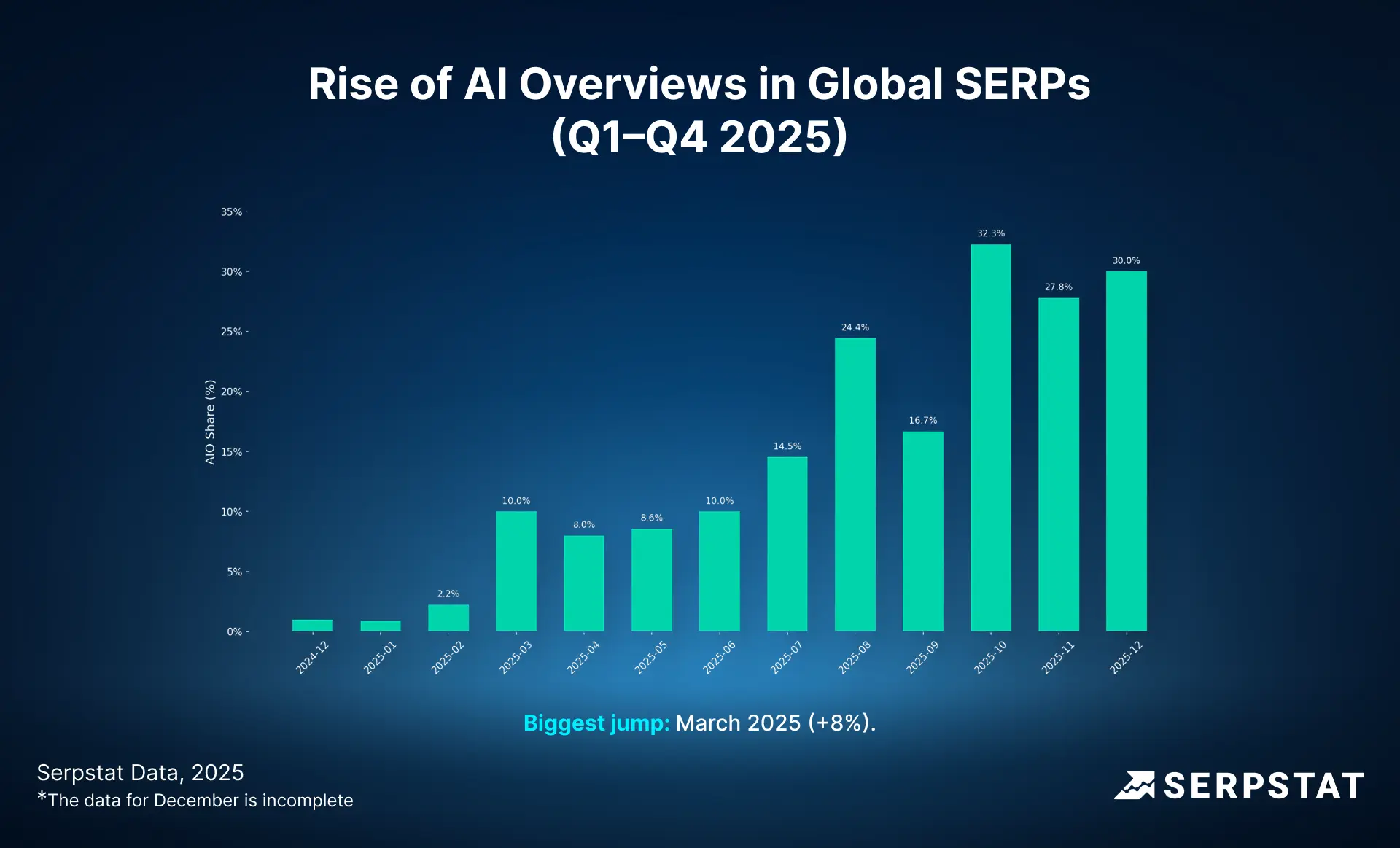
For anyone doing SEO, roughly one in four search queries now triggers an AI Overview, fundamentally changing how users interact with search results and potentially impacting organic click-through rates.
This is a massive shift in just one year. Many people noticed a decline in their Google Search Console clicks. Informational queries play a large role in this.
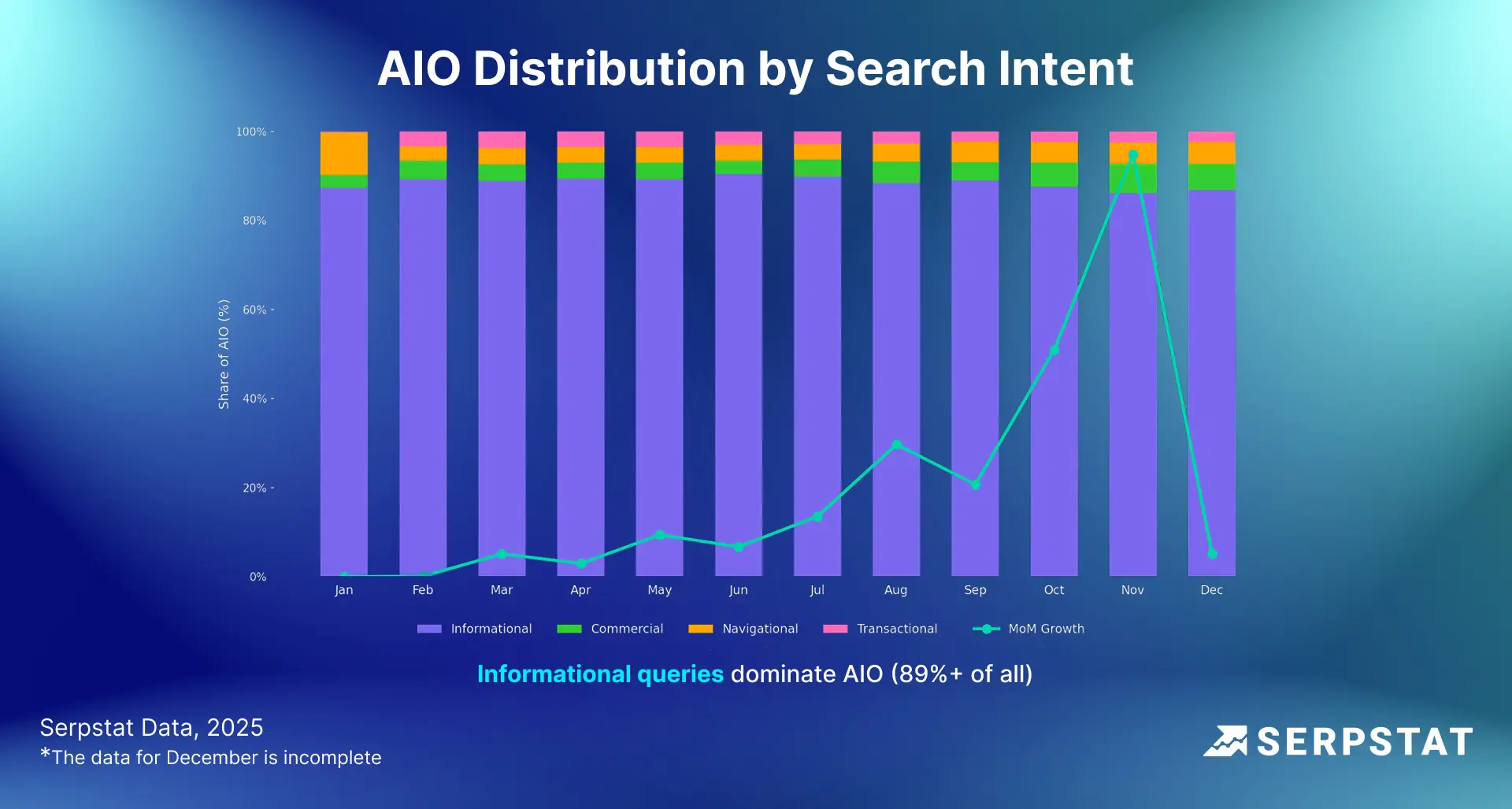
This AI overview Tracking data also reveals a significant gap in how Google deployed AI Overviews across devices. Desktop led the rollout by approximately five months. AIO began appearing on desktop in January 2025. Mobile remained flat at 0% until June 2025, when Google finally switched on AIO for mobile users.

AI Overview Volatility Research
One-time study conducted by the Serpstat team in late May 2025 (May 21–27), examining how stable Google's AI Overviews are on a day-to-day basis across 500 keywords in the US market. The data show moderate volatility overall, with an average daily volatility score of 0.403 on a 0–1 scale. This means the feature is neither completely stable nor wildly unpredictable — there are noticeable changes between days, but results remain generally predictable.
The distribution:
- Low volatility (stable): 28.4%
- Moderate volatility: 33.5%
- High volatility: 31.1%
- Extreme volatility: 7%
The research distinguishes between two sources of volatility:
For SEO practitioners, this data suggests that tracking AI Overview presence requires consistent monitoring — a single snapshot may not reflect typical behavior. The moderate volatility level indicates Google was still actively testing and adjusting AI Overview deployment at the time of this study, though the feature was stable enough to establish patterns.
Since this research represents a single snapshot from May 2025, volatility patterns may have evolved as Google continued refining the feature throughout the year.
AIO Share by Category
The analysis of AIO share across 13 major content categories reveals a clear prioritization of informational and YMYL - Your Money or Your Life content.
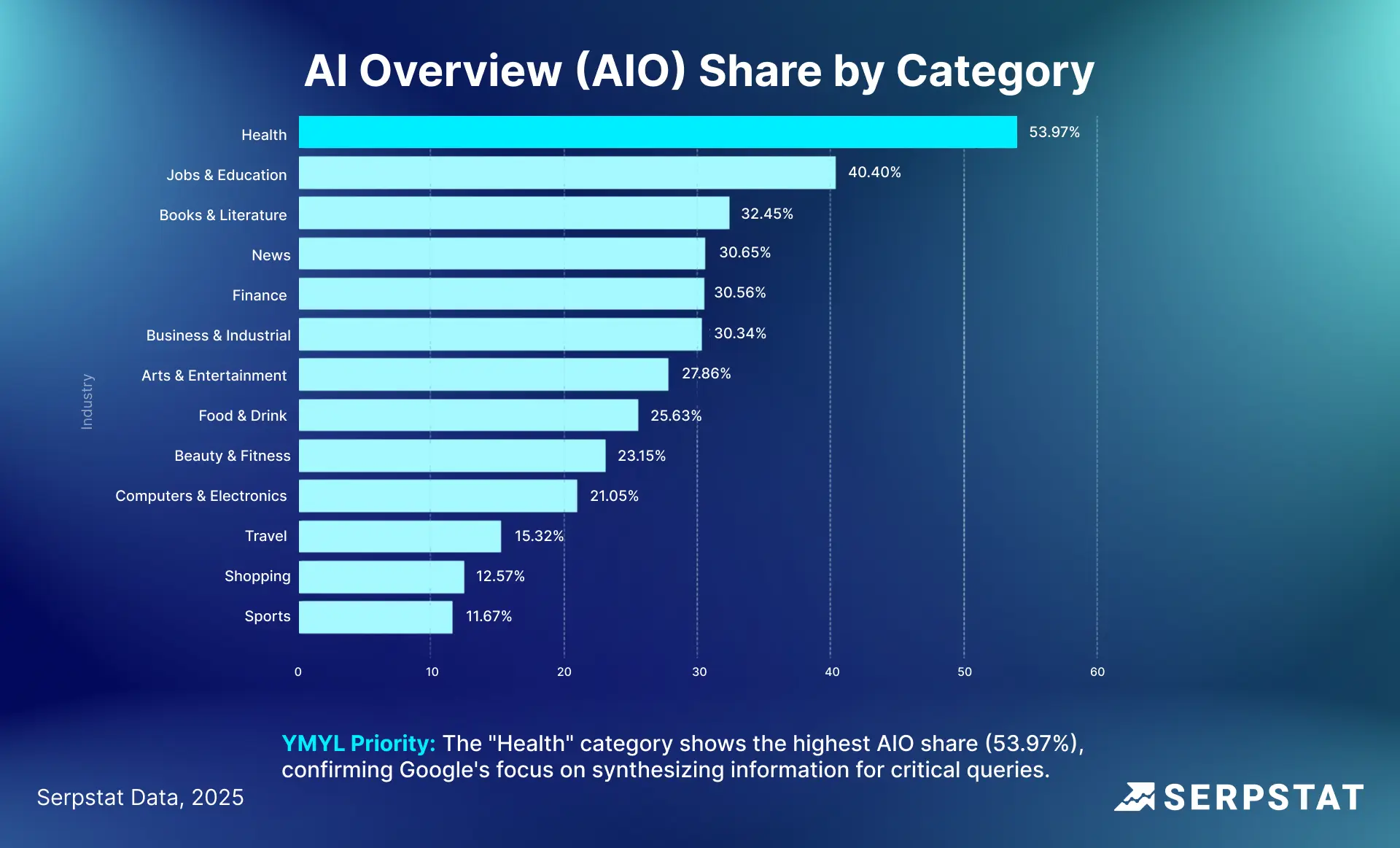
The Health category exhibits the highest AIO share at 53.97%, indicating that Google prioritizes using generative AI to synthesize information for critical health-related queries. Conversely, transactional or highly visual/real-time categories like Sports and Shopping show the lowest AIO penetration.
The AIO Sourcing Strategy
Starting from July 2025, when Serpstat began comprehensive tracking of AIO source attribution, we observed that approximately 4–8% of domains cited in Google AI results also rank in the organic top 20. The remaining 92–96% of AIO sources come from outside the top 20 positions — either ranking lower, not ranking at all for that query, or being sourced from Google's internal knowledge systems.
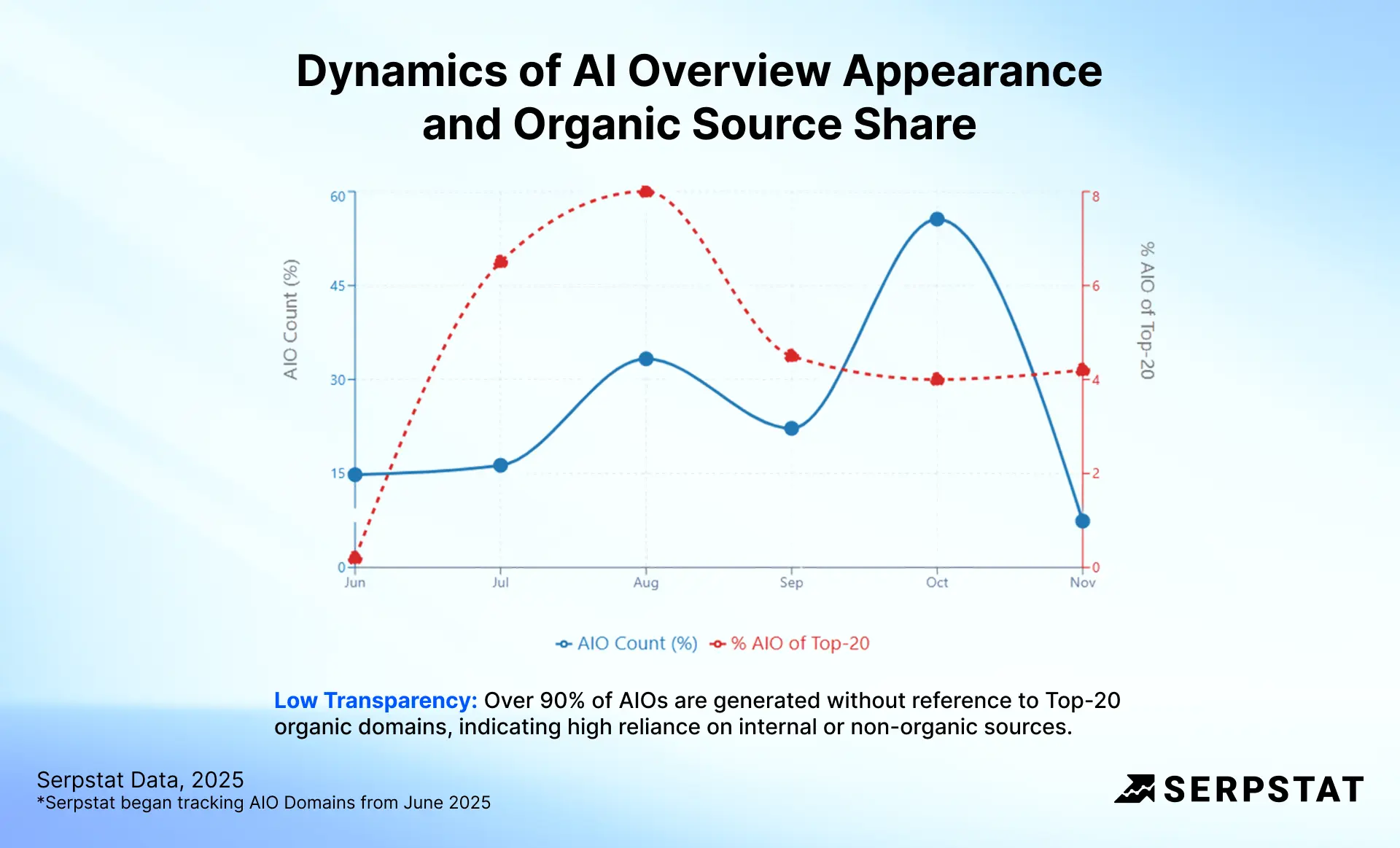
Overlap suddenly appeared and peaked at 8.03% in August, suggesting Google started incorporating traditional ranking signals into AIO source selection. The rate dropped to 4–5% and stabilized.
This suggests that over 90% of AIOs are generated without direct reference to a Top-20 organic result, relying instead on internal knowledge, non-organic sources, or sources outside the Top-20. Ranking well organically doesn't guarantee visibility in AI Overviews, and vice versa.
Our analysis of domains cited in AIO references highlights a reliance on both authoritative and user-generated content (UGC) platforms.

The dominance of YouTube and other UGC platforms (Reddit, Quora) indicates that generative AI overview is trained to value diverse, community-driven, and video content as highly relevant sources. Simultaneously, the strong presence of YMYL/Health domains (NIH, Healthline, Mayo Clinic) confirms a continued focus on authority for critical topics.
AI Overviews are predominantly generated without direct reference to top-20 organic results. However, when Google does cite organic sources, it demonstrates a strong preference for the highest positions: top-5 accounts for 55% of all organic citations, while top-10 provides over 88%.
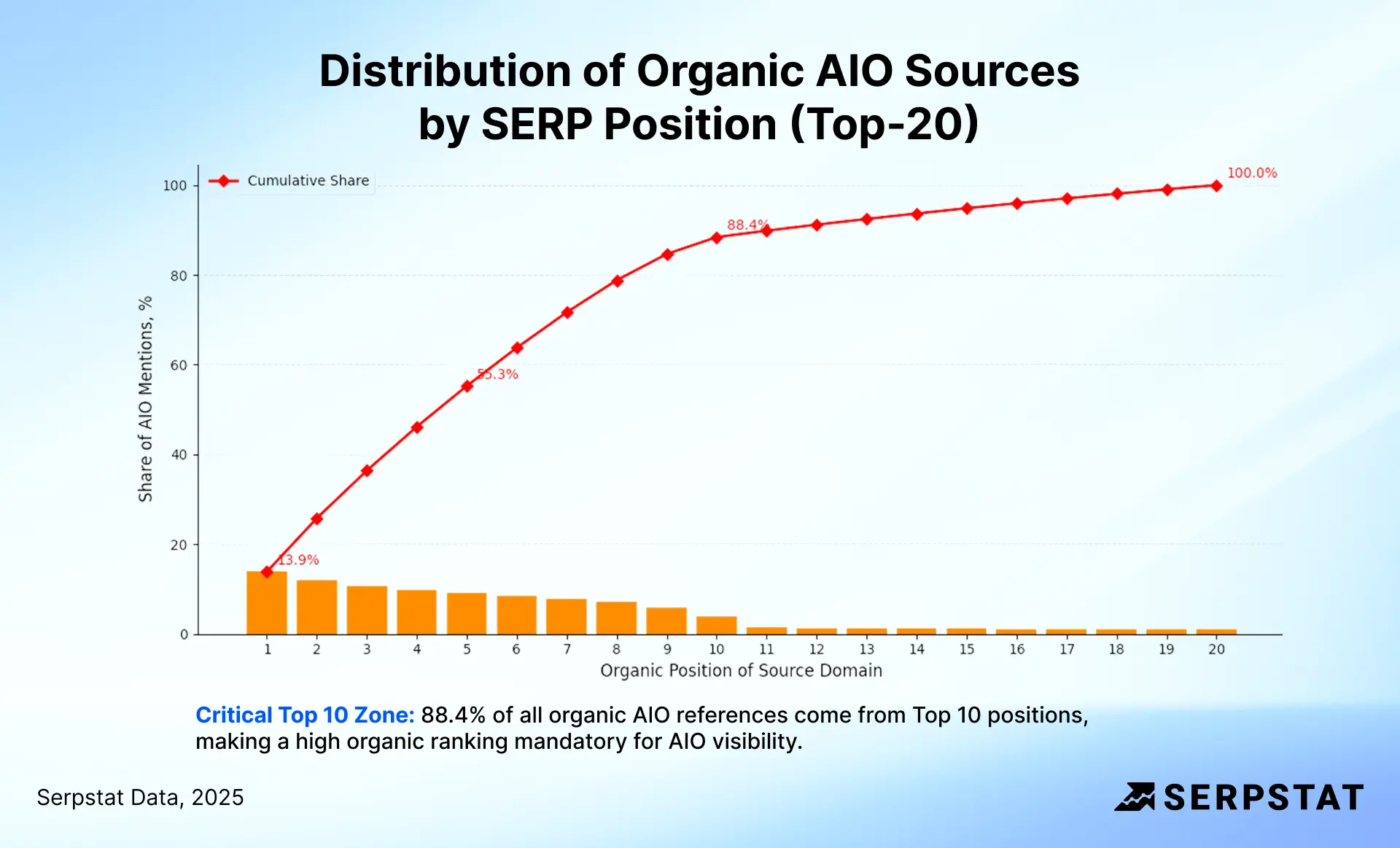
This is not a contradiction — it's a hierarchical selection system. This is the content that Google already deems highly authoritative and relevant (i.e., high-ranking content).
AIO and Feature Snippets
The most striking finding is the relationship between AI Overviews and Featured Snippets. AI Overviews are already nearly three times larger than Featured Snippets.
Google is actively replacing Featured Snippets with AI Overview rather than running them in parallel. Featured Snippets remained relatively stable — until Google apparently stopped showing them together entirely in Q4 2025.
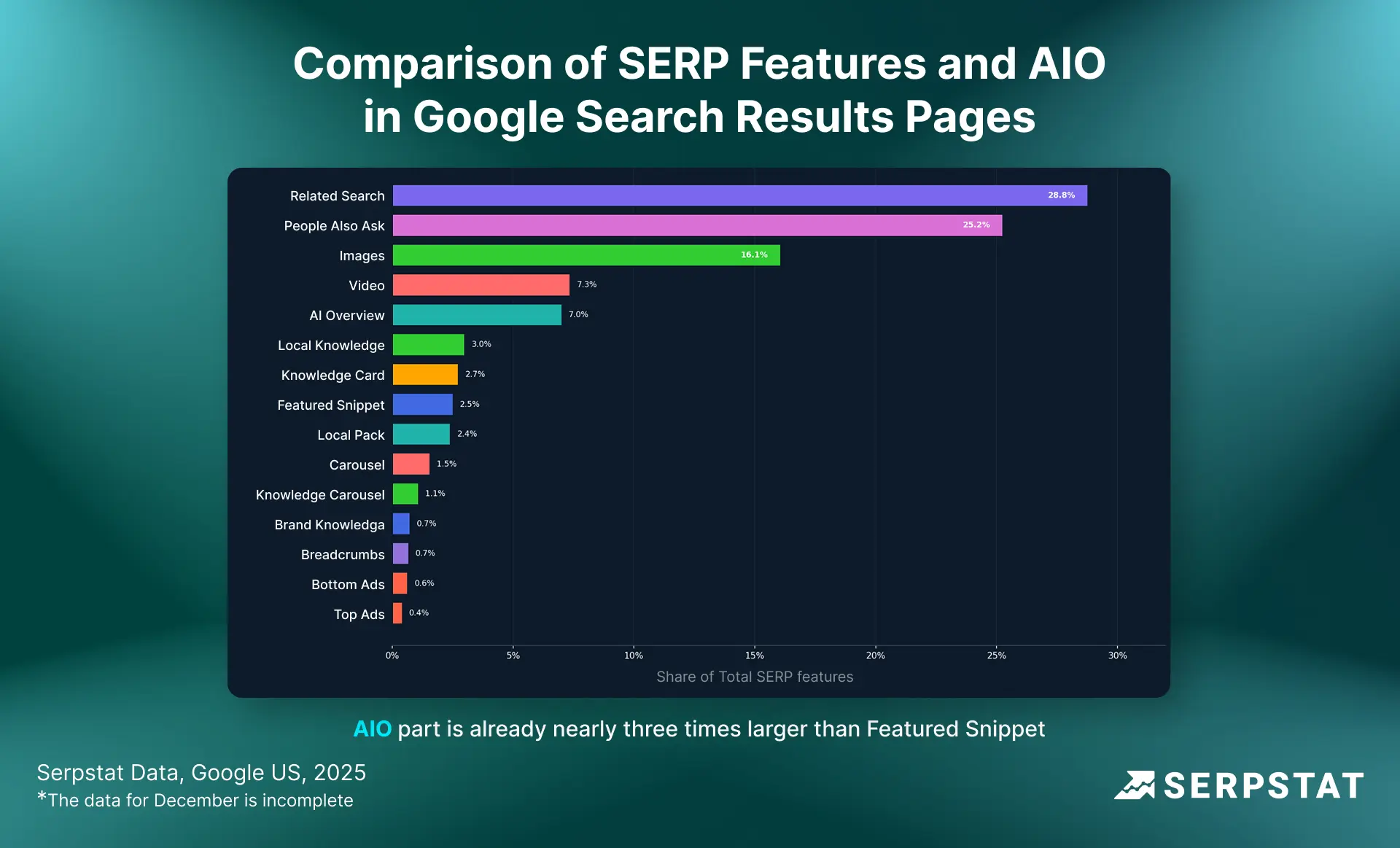
We can think of AIO as a continuation and evolution of the featured snippet concept — both elements target the same type of query where users expect a direct, immediate answer.
AIO Share Correlation with Query Length
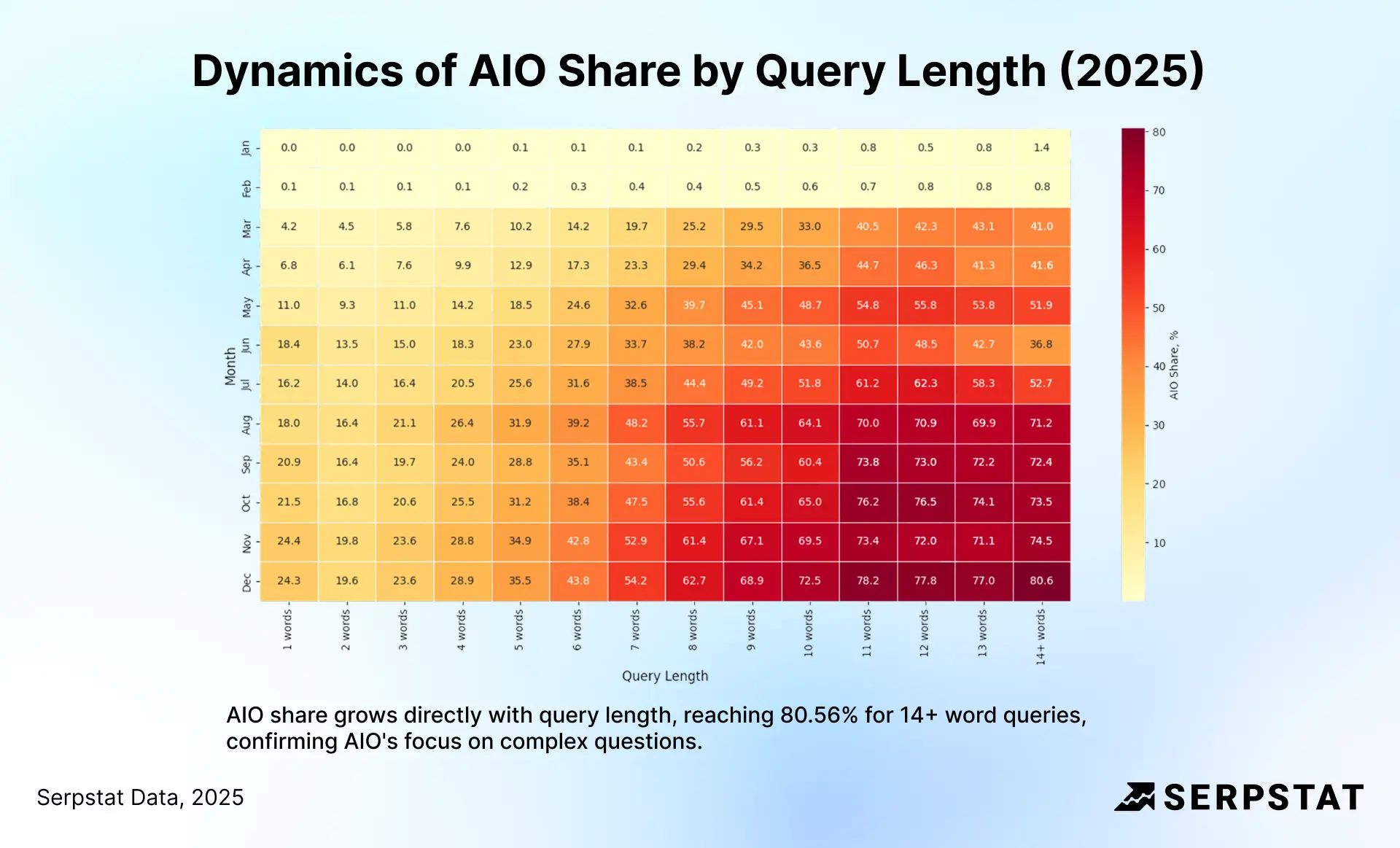
The analysis of AIO share based on query length strongly supports the long-tail keyword research practice. There is a strong, positive correlation between query length and AIO share.
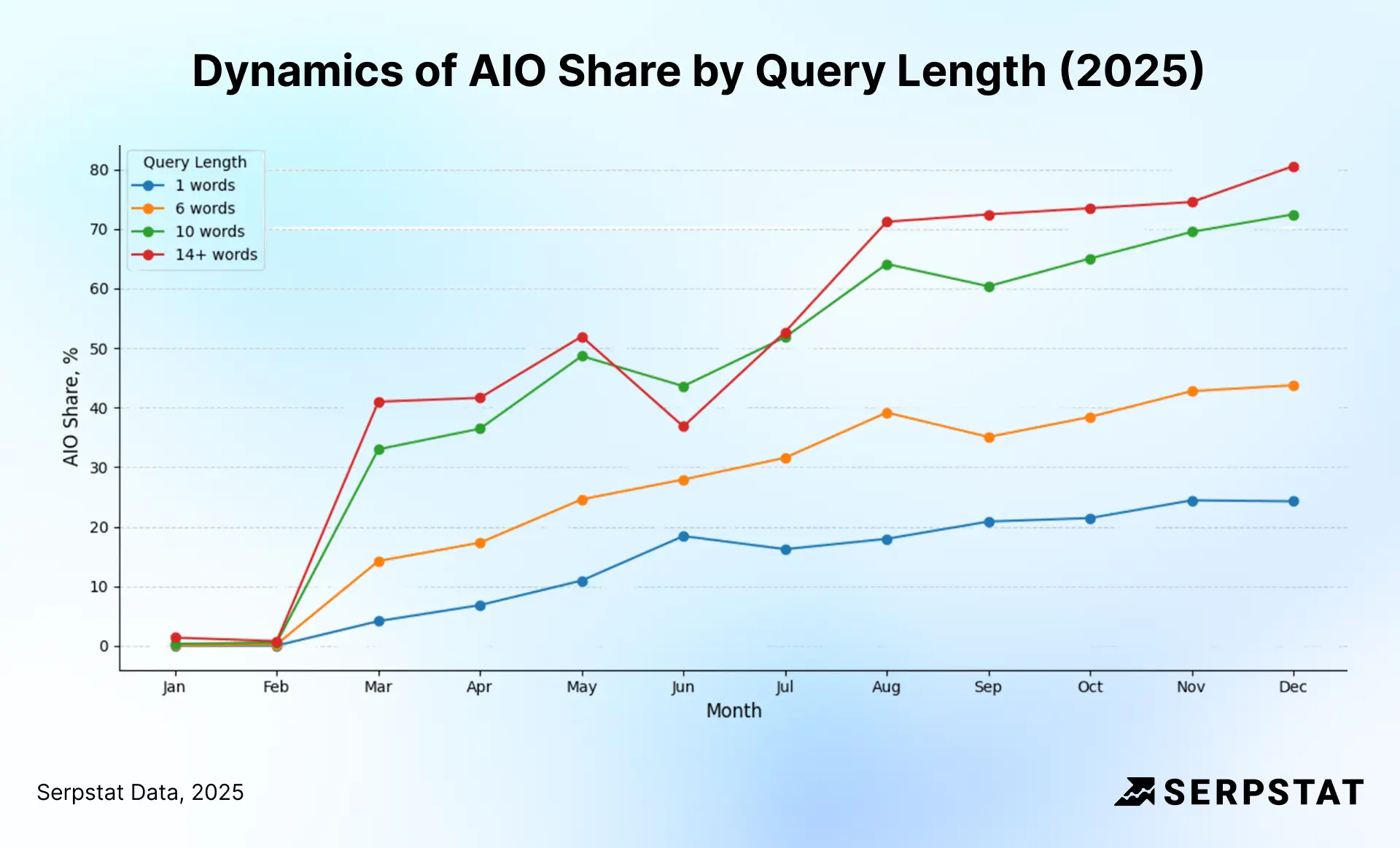
Queries with 14+ words have an AIO share of 80.56%, compared to only 24.27% for 1-word queries. This indicates that AIO is primarily deployed to synthesize complex, specific, and often question-based queries that are difficult to satisfy with a single traditional search result.
Queries with 14+ words have an AIO share of 80.56%, compared to only 24.27% for 1-word queries. This indicates that AIO is primarily deployed to synthesize complex, specific, and often question-based queries that are difficult to satisfy with a single traditional search result.
Summary: How To Rank in AI Overviews
This AIO-SEO data paints a clear picture of Google AI summary as a rapidly expanding feature designed to handle complex, informational queries, particularly in YMYL sectors. While AIO's reliance on organic Top-20 results is low, the sources it does use are highly concentrated in the Top 10, confirming the continued importance of high organic ranking.
The heavy use of UGC platforms (YouTube, Reddit) suggests a shift in what Google considers a valuable source for generative answers. High-quality video content and active community engagement are now direct contributors to AIO visibility.
Content strategy should aggressively target complex, multi-word queries (7+ words) that have the highest AIO share. This content should be structured for easy synthesis (e.g., clear headings, bullet points, FAQs). The answers you provide need to support your topics and help your readers understand them. It also facilitates the generative model in extracting and citing key facts.
For health and finance topics, content must adhere to the highest standards of authority and expertise to compete with established sources like NIH and Mayo Clinic.
We hope these insights will help you gain more traffic and clicks from SERPs. Best wishes, and please share this research with your colleagues :)
Discover More SEO Tools
Backlink Cheсker
Backlinks checking for any site. Increase the power of your backlink profile
API for SEO
Search big data and get results using SEO API
Competitor Website Analytics
Complete analysis of competitors' websites for SEO and PPC
Keyword Rank Checker
Google Keyword Rankings Checker - gain valuable insights into your website's search engine rankings
Recommended posts
Cases, life hacks, researches, and useful articles
Don’t you have time to follow the news? No worries! Our editor will choose articles that will definitely help you with your work. Join our cozy community :)
By clicking the button, you agree to our privacy policy.