How to Measure Share of Search for SEO and Brand Growth

Wouldn't it be nice to know how often people search for your brand instead of your competition? That's exactly what share of search (SoS) can tell you.
And while some treat it as a vanity metric, it's far from that.
SoS can help you understand your current brand awareness and predict trends. In fact, it's a leading indicator of your market share, which shows where your entire business is heading.
That's why in this guide, we'll help you understand:
• How to approach and calculate this metric
• Whether you need it at all
• The best ways to grow your brand share of search in both traditional search and LLMs
What Is Share of Search, and Why Does It Matter?
Share of search is a metric that shows the percentage of branded searches you get relative to all branded search volume in a given category.
Simply put, out of all the searches for businesses in your category, how many include you specifically?
Why does it matter? SoS helps you understand whether your marketing is creating real brand interest.
You might be writing blog posts, posting on socials, using a guest posting platform to get backlinks, and working on your paid channels. But does all that make your brand more recognizable?
This is a question the share of search metric can help you answer.
One of the most interesting benefits, though, is how the share of search predicts market share. According to Les Binet, if the SoS goes up, market share tends to increase as well, and vice versa.
If you look at the graph below, the SoS predicted the market share drop six months before it actually happened.
So, if a brand tracks its SoS in combination with other metrics, it can foresee these changes and pivot its strategies before it's too late.
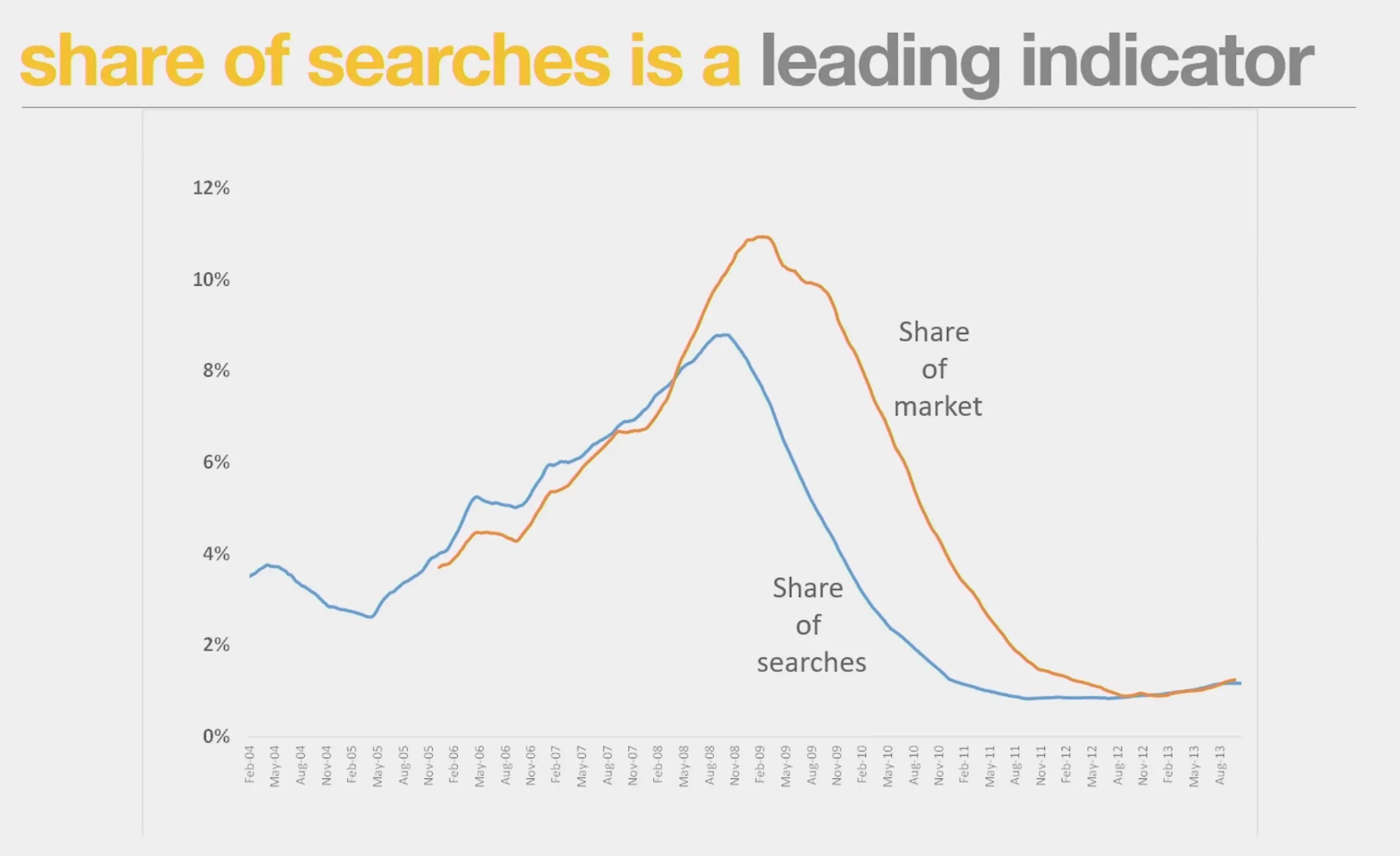
Source: IPA
Still, this metric is directional and shouldn't be used in isolation because:
• The numbers you use to calculate it in the first place might not be fully accurate
• People can search for a brand for different kinds of reasons (not always positive ones)
• If your brand name isn't unique, it's hard to separate branded searches from generic ones
• Not every user looking for your brand is an actual lead
So, when you start measuring this metric, don't treat it as the full picture. It's just one number. That's why combine it with other data that shows you the quality of those searches. These are things like user behavior, conversion rates, etc.
Share of Search vs. Share of Voice vs. Market Share
Each of these metrics can help you understand how successful your brand is. But they do it from different angles:
• Share of search (SoS) shows how successful you are in search compared to other similar brands
• Share of voice (SoV) shows your visibility compared to your rivals. Usually, it's measured for a particular channel, like a social media platform, PPC, etc.
• Market share is a sales-based metric that measures how your sales (revenue) compare to those of your rivals. It helps understand how much of the market your business owns
The Share of Search Formula
The basic SoS formula is straightforward: divide your branded searches by the total branded search volume of your selected competitors in a specific niche/selection/category.
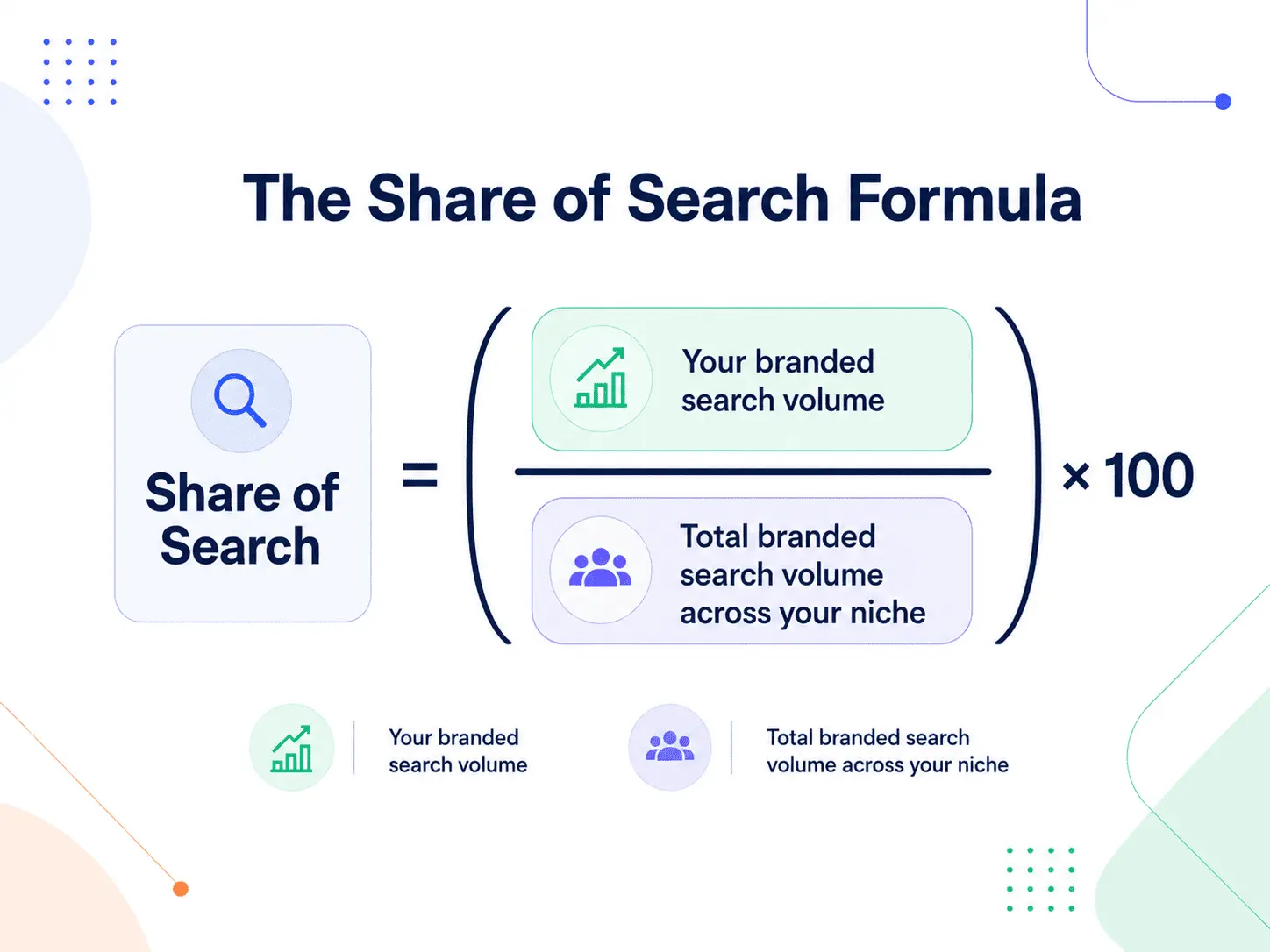
Let's take a look at an example:
Say, you have 20,000 branded searches. And your competitors A, B, and C have 35,500, 12,500, and 22,000 branded searches.
In this case, your SoS would be: 20,000 ÷ (20,000 + 35,500 + 12,500 + 22,000) × 100 = 22%.
SERP Visibility Share
Even though SoS refers to how often users search for your brand name, it isn't a synonym for SERP visibility.
SERP visibility is a metric that goes beyond your branded searches. Every SEO tool calculates it differently. But they always consider the search volume of the queries you rank for and your positions for each of those.
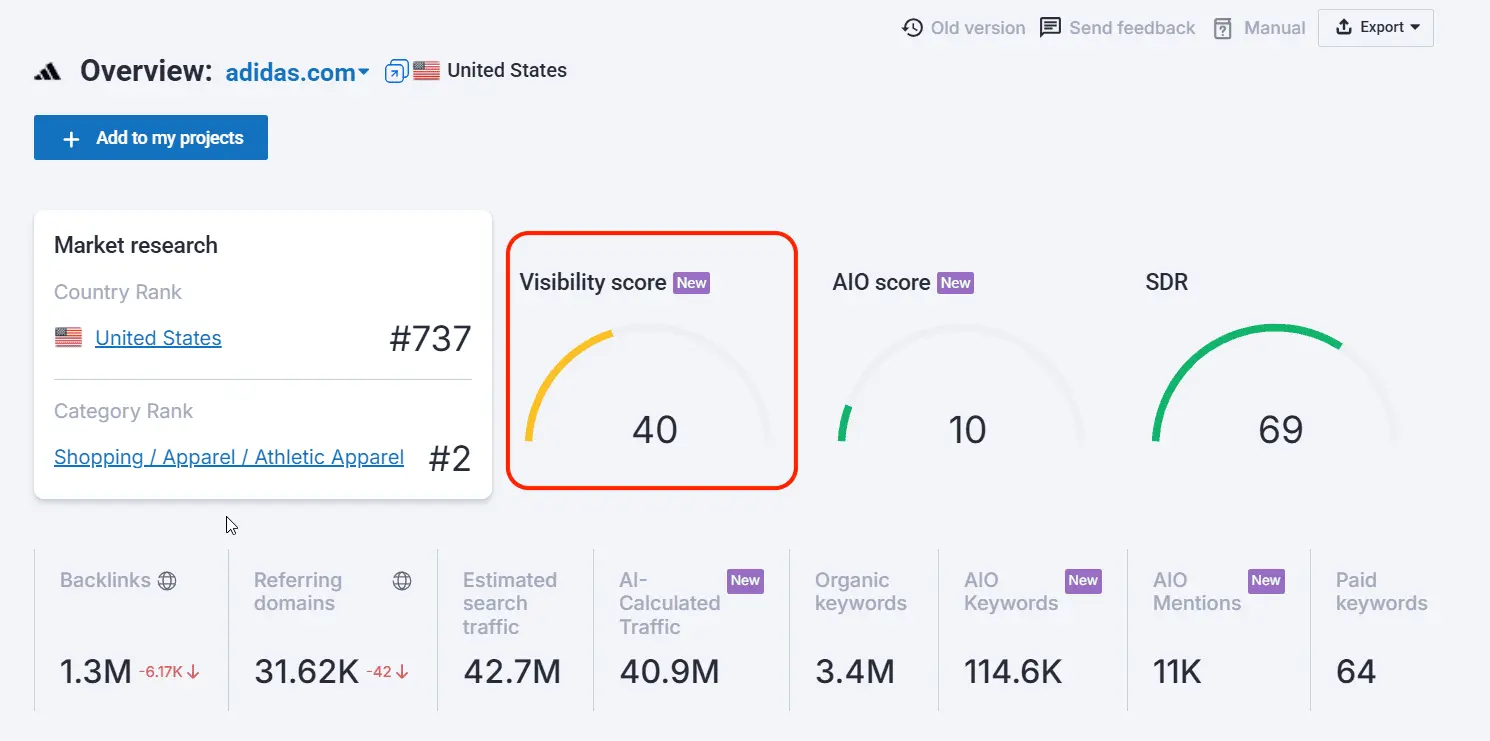
You can calculate your SERP visibility by simply checking a visibility score in your SEO software (the name might differ, depending on the tool).
Here is how it looks in Serpstat:
After you find your score, use a similar formula:
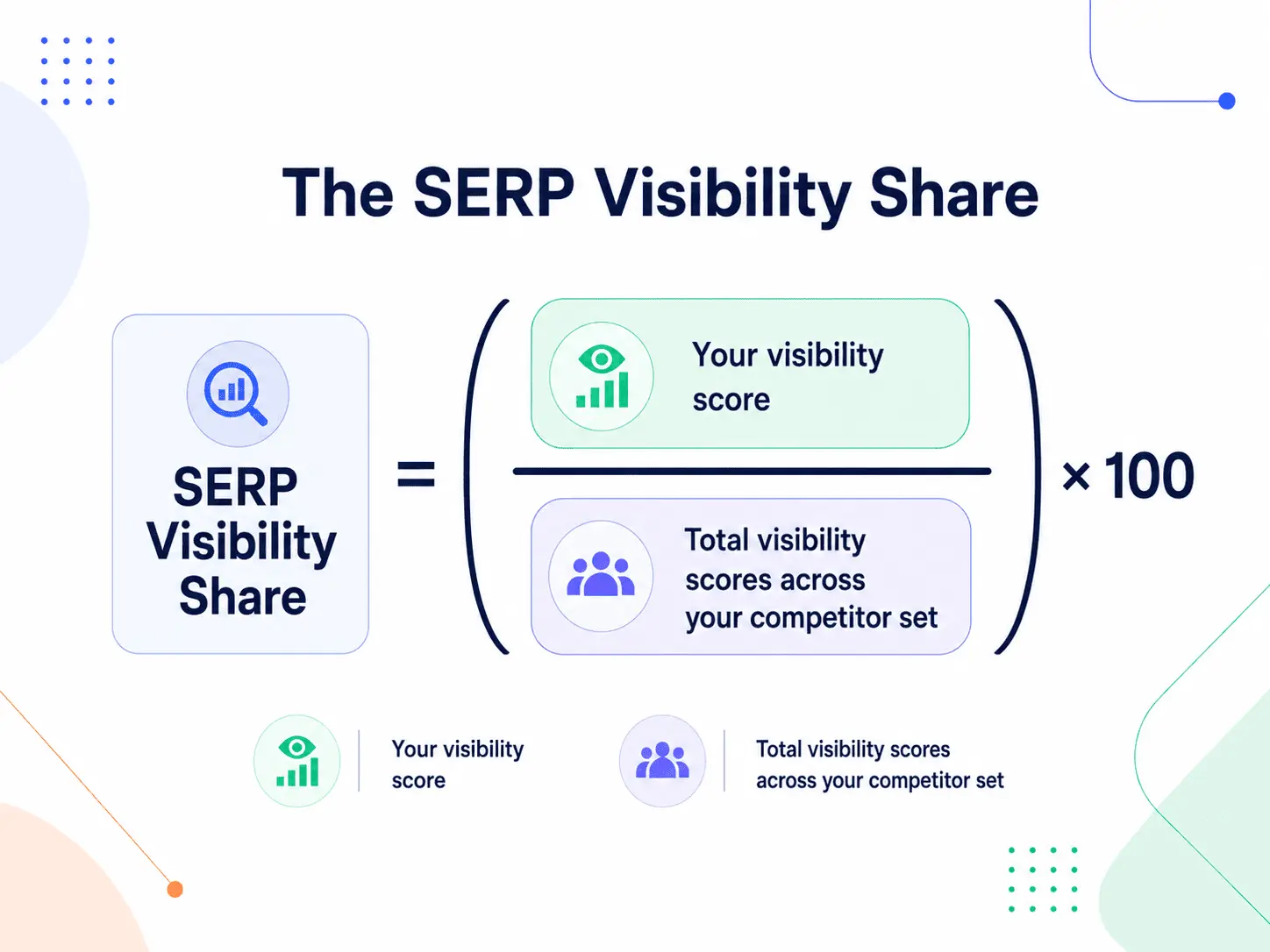
This is how it could work in real life:
Let's imagine you have a visibility score of 35. And you want to compare it with companies A, B, and C that have scores of 42, 17, and 32.
Then, your SERP visibility share would be: 35 ÷ (35 + 42 + 17 + 32) × 100 = 28%.
Brand Visibility Share
SoS isn't the overall brand visibility either, as it isn't limited to search only. But the formula you use here is almost identical:
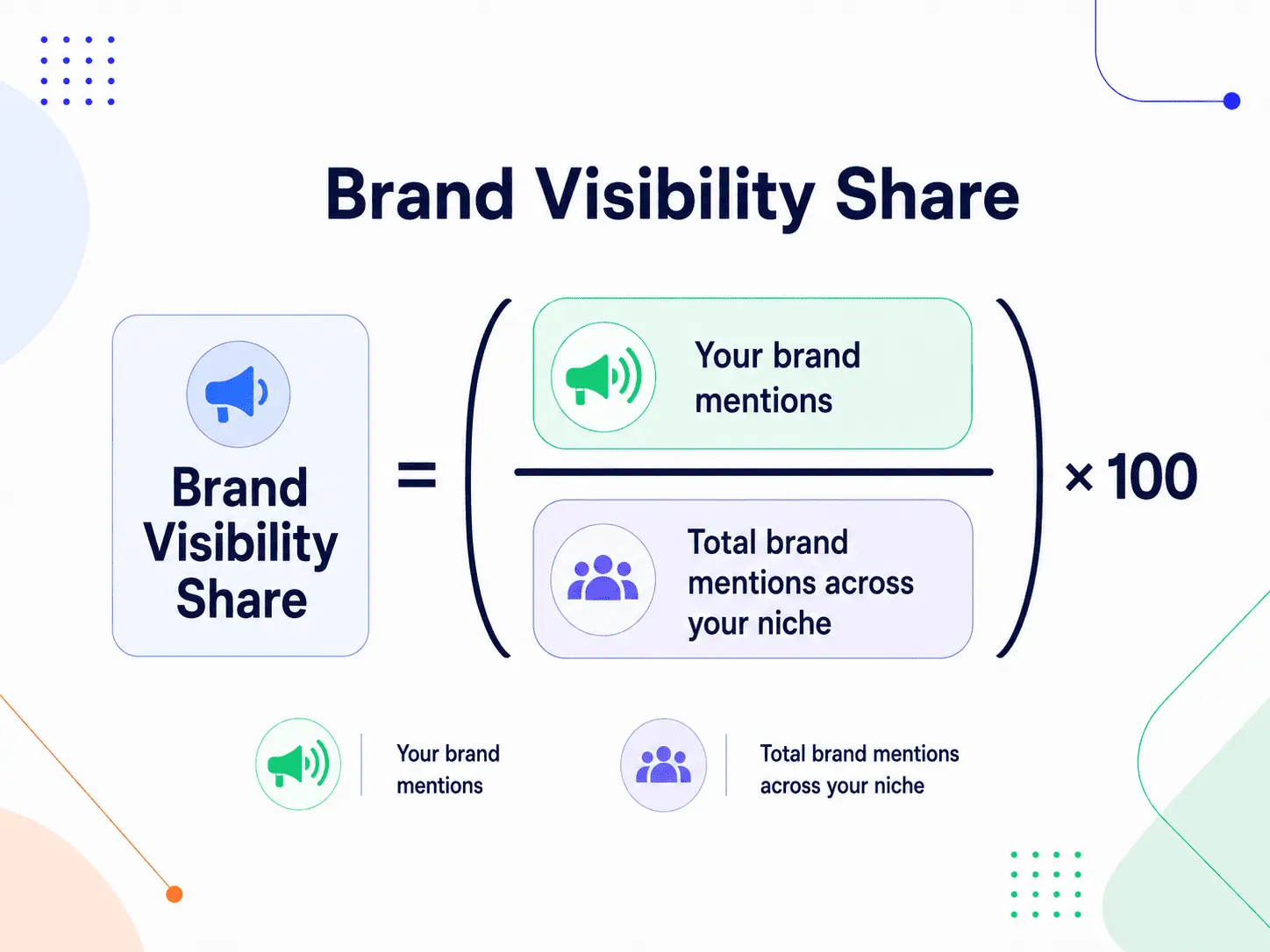
You can track the broader visibility of your business with a social listening tool (Brand24, Brandwatch, SproutSocial, etc.). And most platforms will calculate your share automatically.
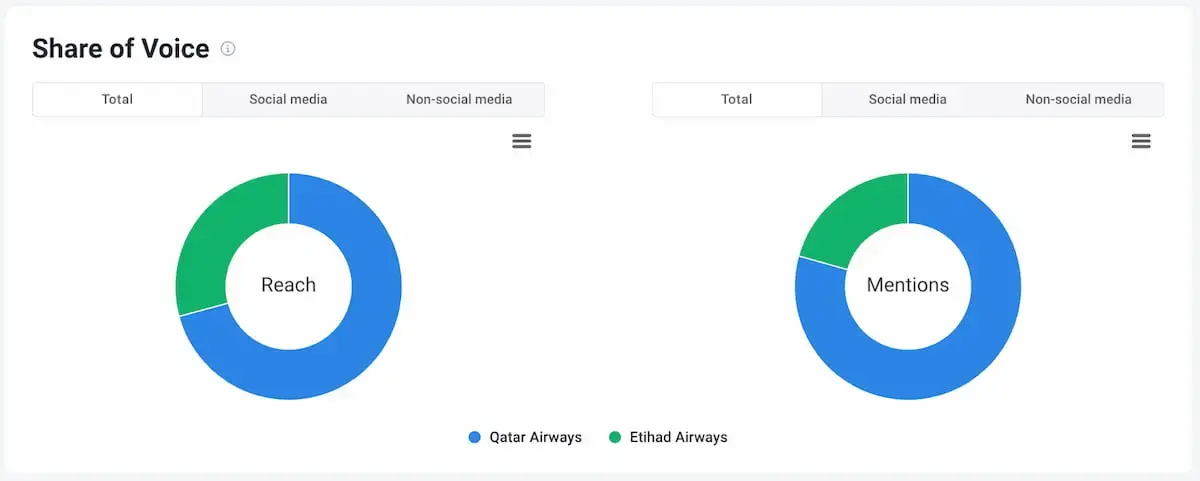
Source: Brand24
AI Visibility Share
The share of search metric was around before AI search. So, it doesn't really account for it.
But a similar formula would apply to the AI visibility share. Take your AI visibility score and divide it by the total of your competitors' scores.

For example, this metric in LLM Brand Monitor (LBM):
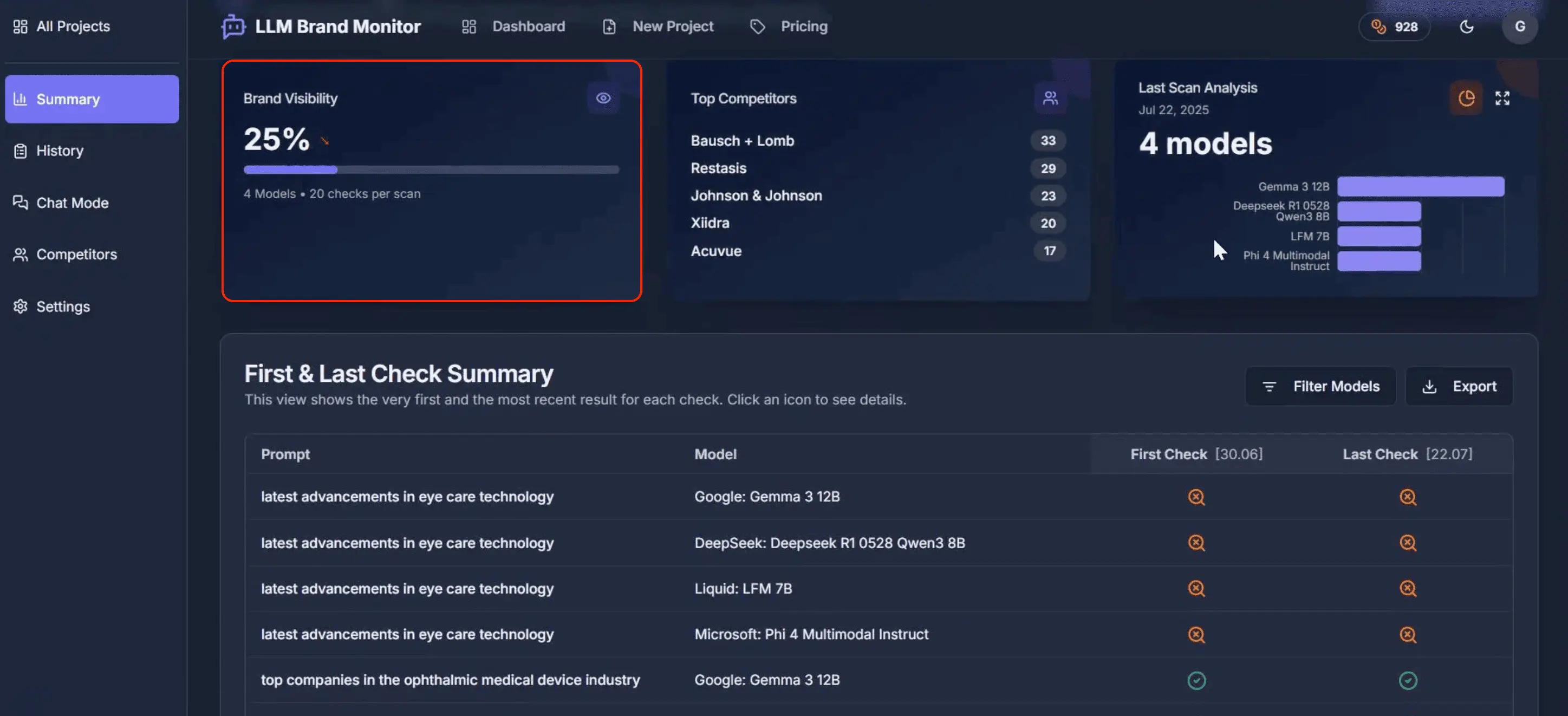
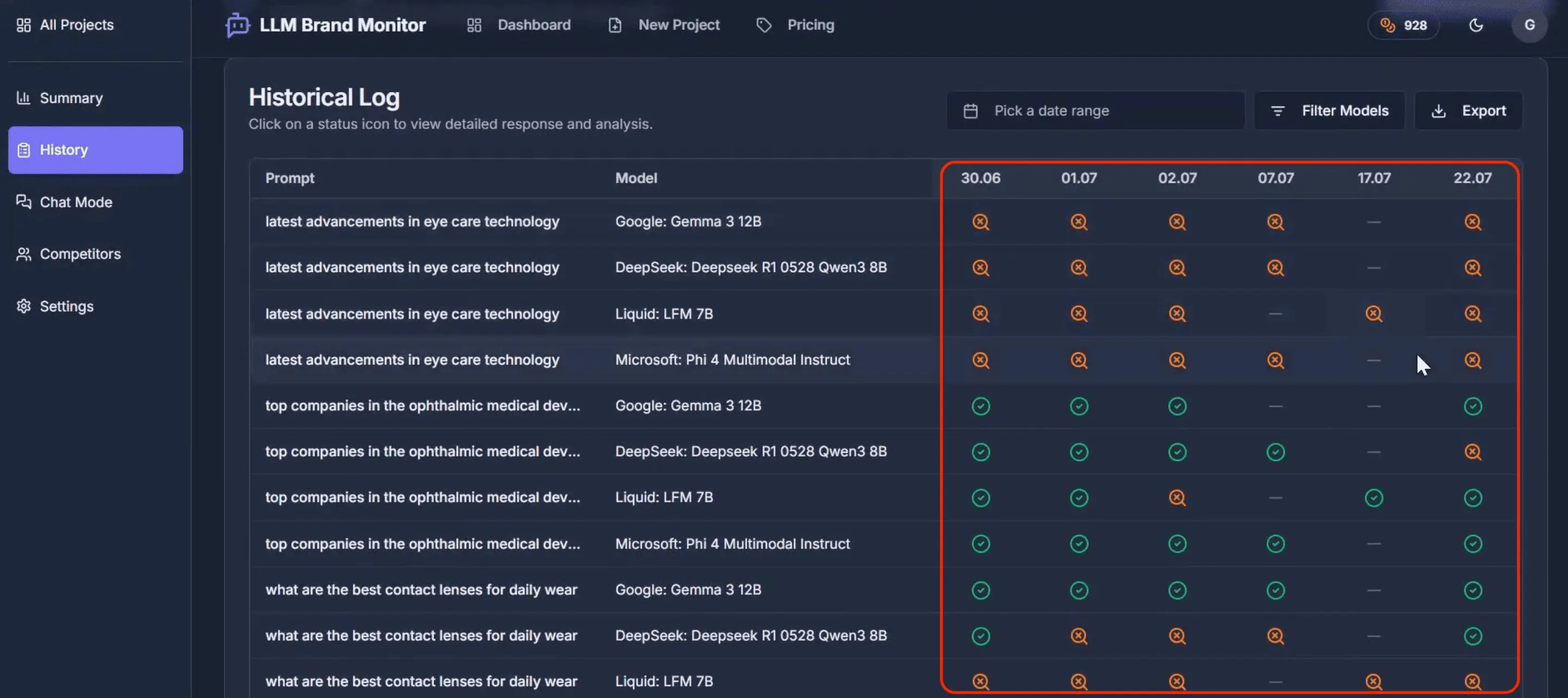
Brand Visibility here is the share of successful checks from the last scan where your brand was mentioned. Higher means more frequent mentions. Further, we will see how to set up the entire process.
If we use the scores from here, our AI visibility share would be 25 ÷ (25 + 33 + 29 + 23 + 20 + 17) × 100 = 17%.
You can also calculate it separately for AI Overviews or different LLMs, depending on your needs and the capabilities of the platform you're using.
How to Measure Share of Search
When it comes to measuring the SoS in the traditional search, there are mainly two options: an SEO tool or Google Trends.
Option 1: SEO Tools
Use Serpstat to compare branded keyword demand, track visibility trends, and connect search demand with broader brand performance.
For example, let's take Ford, Chevrolet, Toyota, and Honda and compare their search volume.
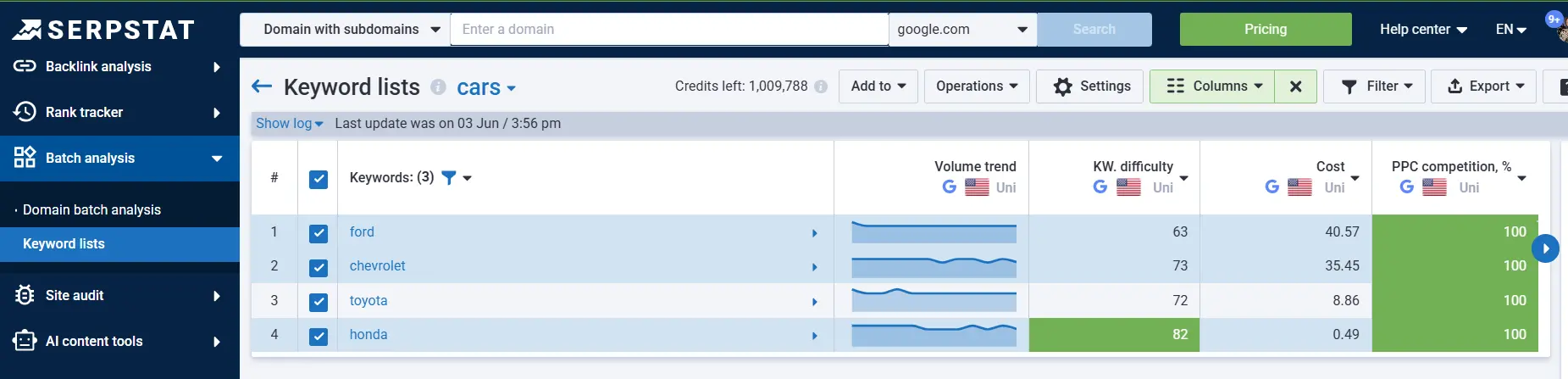
When you find the search volume of each branded keyword, simply use the share of search formula we've covered in the beginning.
In addition, you can use the Keyword search volume history data. It will allow you to track how branded keyword search volumes have been changing over time.
Option 2: Google Trends
Google Trends is a free alternative that's great for a quick check.
While the results you get aren't the exact number of branded searches, you still get an idea about how popular your brand is in search compared to others.
The process here is straightforward. Open Google Trends, choose your market location, type your brand name, and add your competitors:
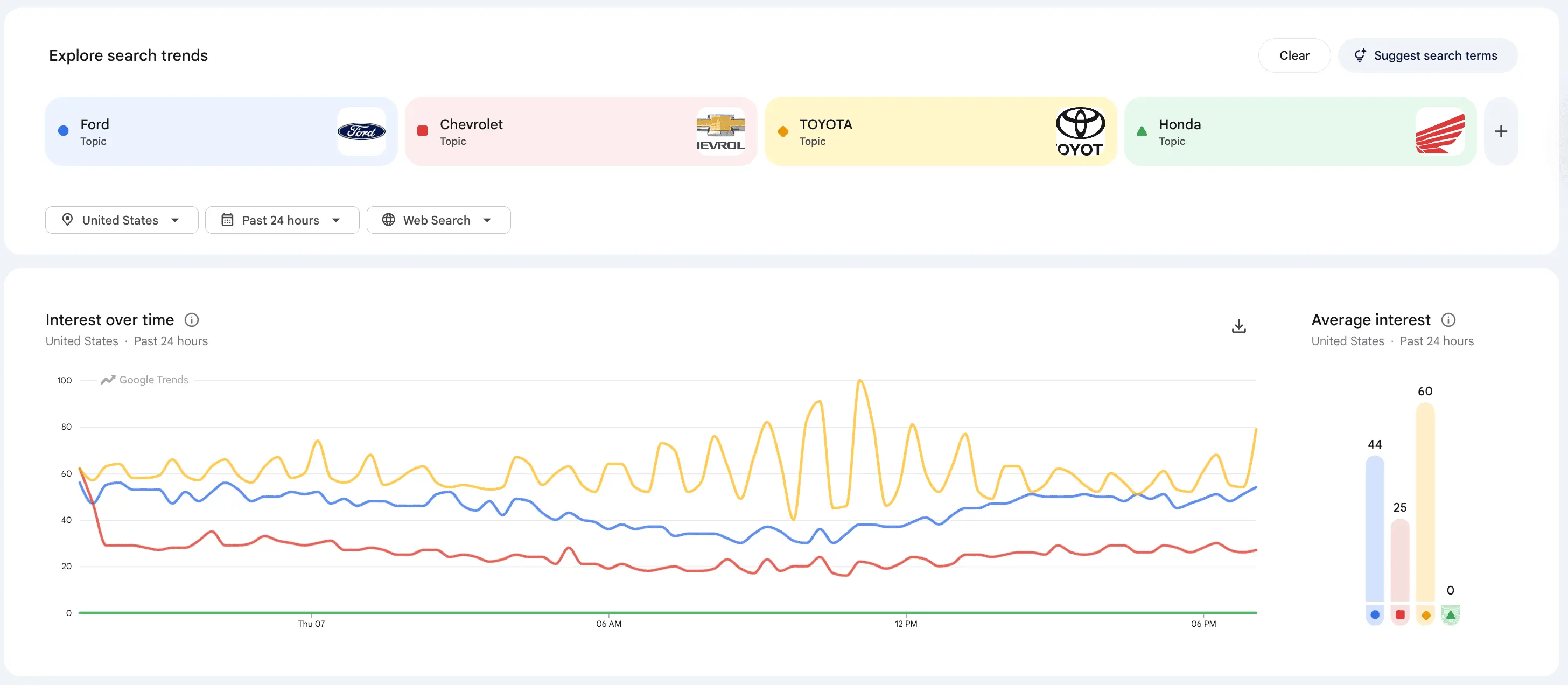
Source: Google Trends
Tip: You can try using the "Topic" type instead of "Search term", where possible, to see all variations of the brand name
How to Measure SoS in AI Search and LLMs
37% of users start searches with AI instead of Google. This is huge, so if you want to future-proof your business, AI search brand monitoring is a must.
This is how you can do it in LLM Brand Monitor. This tool helps you understand how top AI models describe your brand or your competitors. Besides, you can track the real-time sentiment and reputation insights across all the major LLMs.
1. Click New Project, type your brand name, pick the LLMs you're interested in, and click Generate Queries with AI. The tool will generate 10 relevant prompts based on your brand.
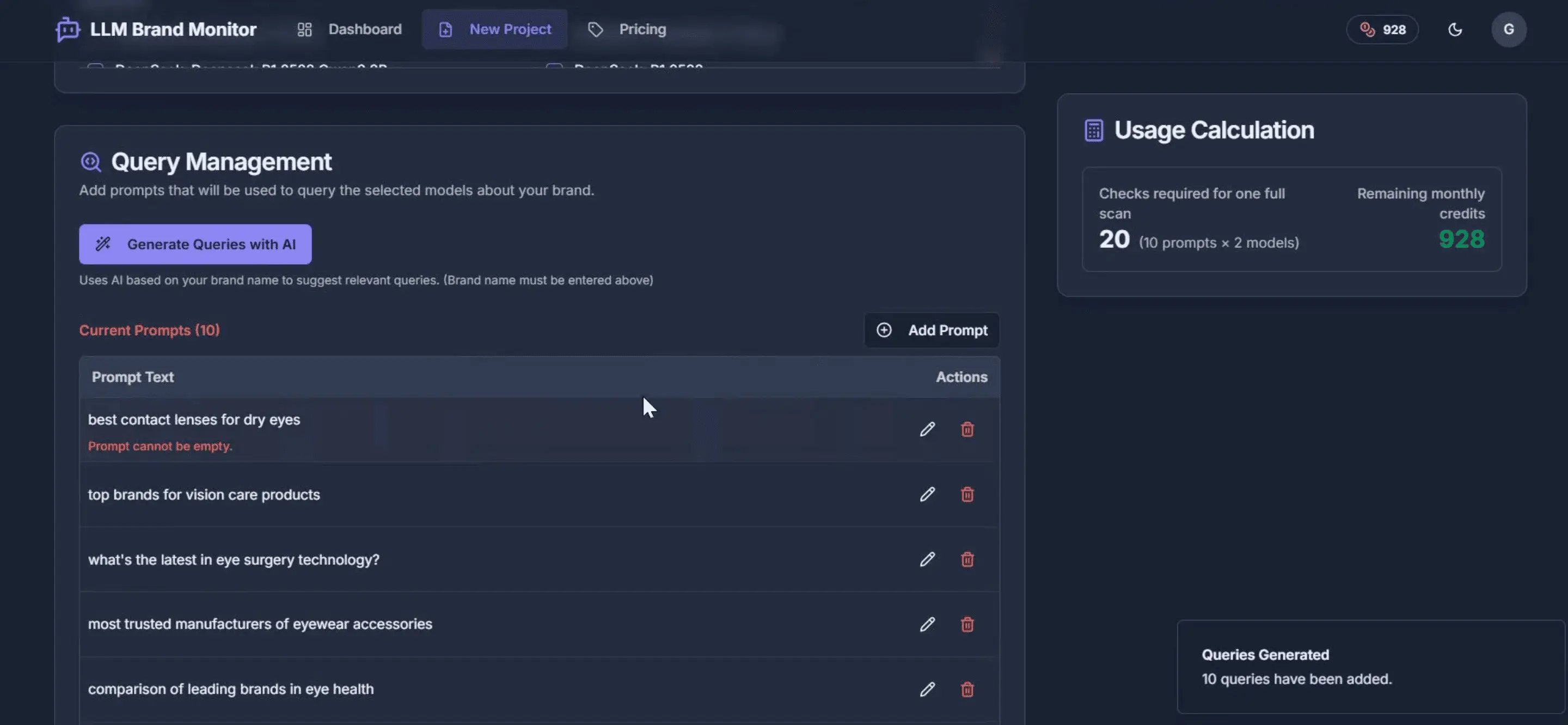
2. Then run the scan to check your Brand Visibility and compare it with other brands.
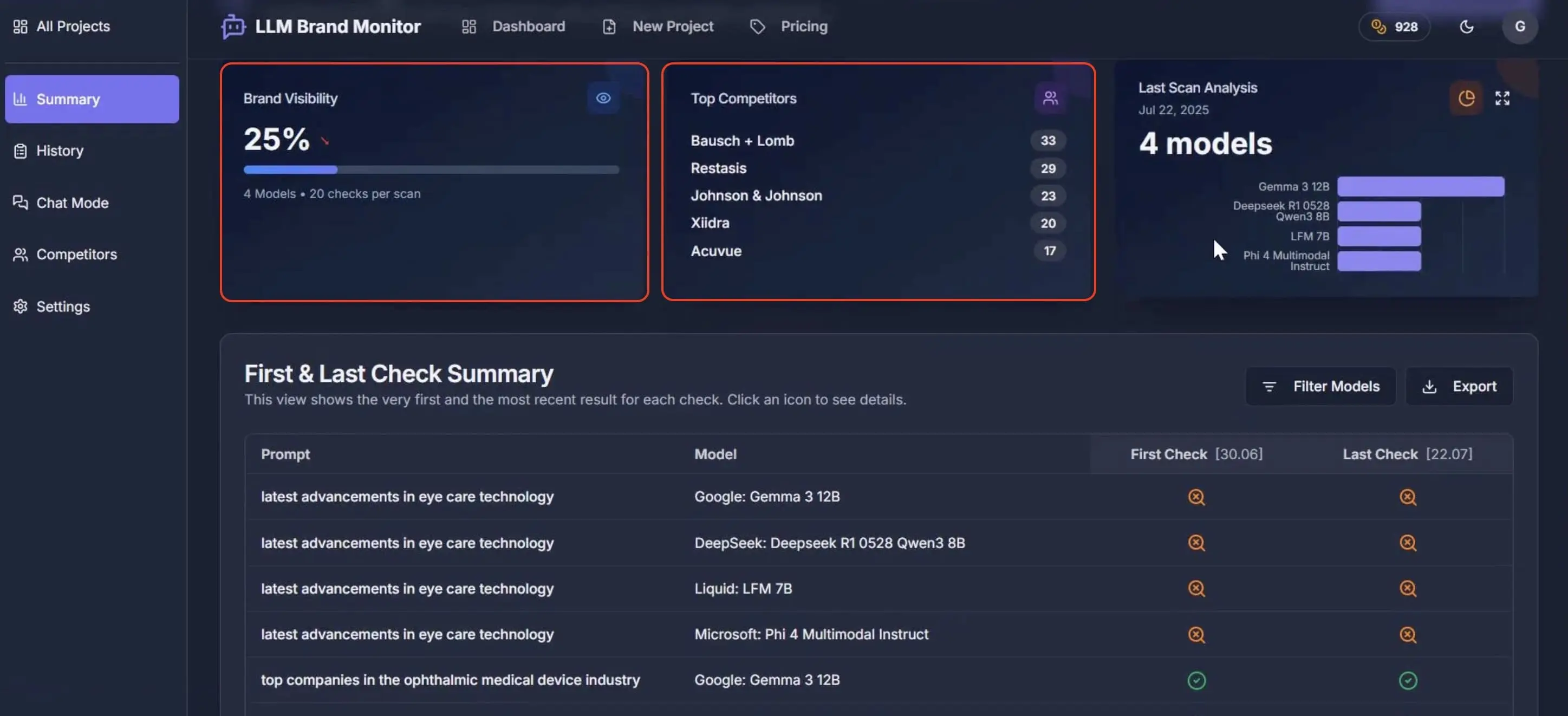
3. When you click the Top Competitors tab, you get even more details about their performance.
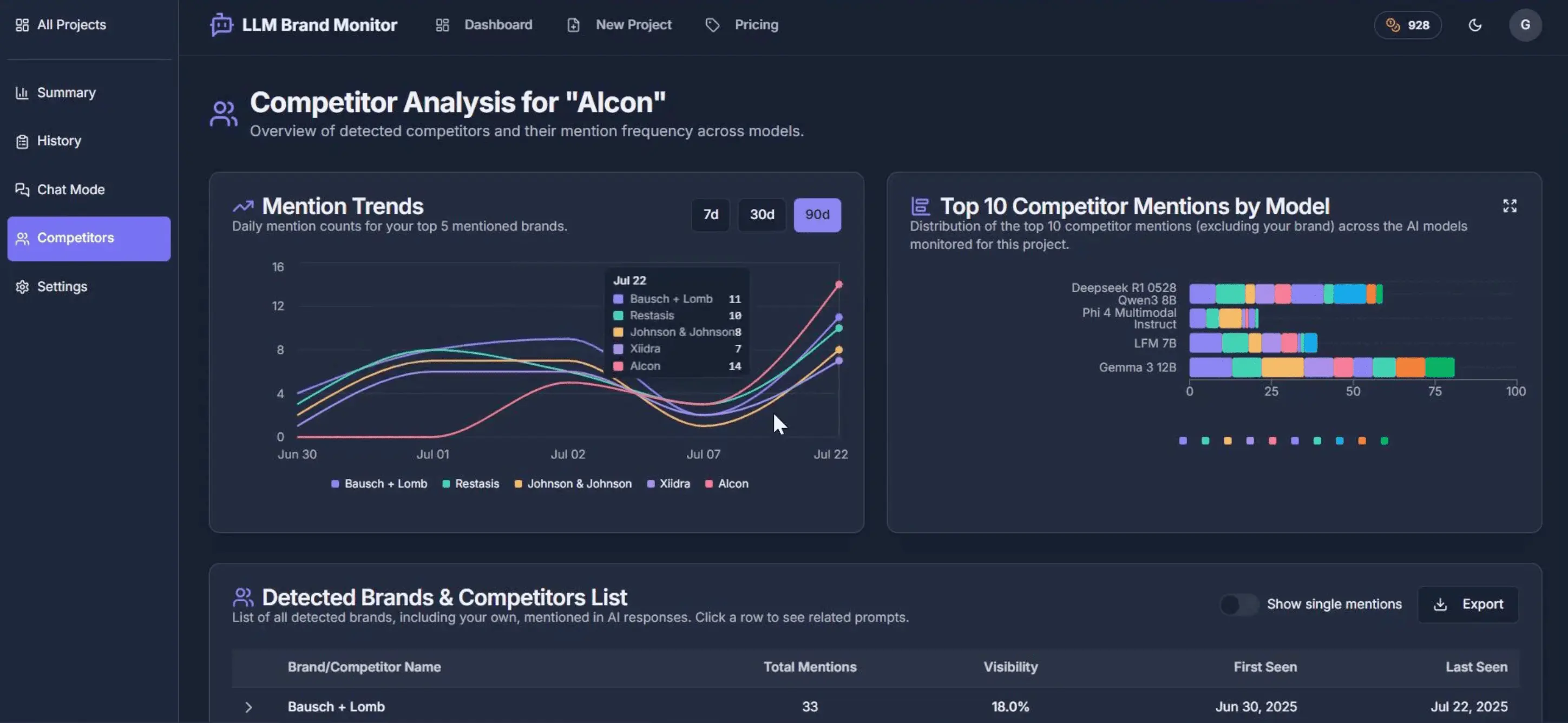
It isn't just about knowing how you and your competitors are doing in AI search. You can see the exact queries and answers where they show up and which pages LLMs cite.
By studying these, you can adjust your own content to improve relevance and have more chances of appearing in AI answers.
Besides, LLM Brand Monitor helps track changes, providing access to the search history. This way, you can measure your performance over time.
7 Tactics to Grow Your Share of Search
Now, let's take a look at the exact strategies that can help you improve your share of search.
1. Analyze Who Mentions Your Competitors
The whole idea of SoS is measuring how you're performing compared to other brands in your category. That's why it's so important to do competitor analysis to check how they're getting external mentions and building search relevance.
The easiest way to learn from your competition is by using a special tool to check:
• What tactics/channels they use to improve their visibility (Where do they publish guest blogs? How do they approach digital PR? Are they active on Reddit and Quora?)
• What pages could potentially link to you as well
The main goal here is to understand what opportunities you're missing out on.
2. Do High-Quality PR
By definition, PR is responsible for building and maintaining a brand image. So, if you want to improve brand visibility metrics, including SoS, you have to build a stronger brand. This is where high-quality PR can help.
Besides, digital PR strategy is even more valuable in the age of AI because even nofollow links and unlinked mentions can improve your AI search visibility.
While PR is a broad field, some of the easiest entry points are:
• Publishing press releases in reputable media
• Participating in conferences or sponsoring some industry events
• Collaborating with some relevant bloggers
• Generating more newsworthy and original content, and so on
3. Show Up in Listicles
Probably you've noticed how popular listicles have been lately. Listicles are essentially blog posts with the selection of the best/top tools, businesses, platforms, solutions, etc. Well, there is a good reason for that. Apparently, they are the most-cited type of content in LLMs, accounting for almost 22% of all citations.
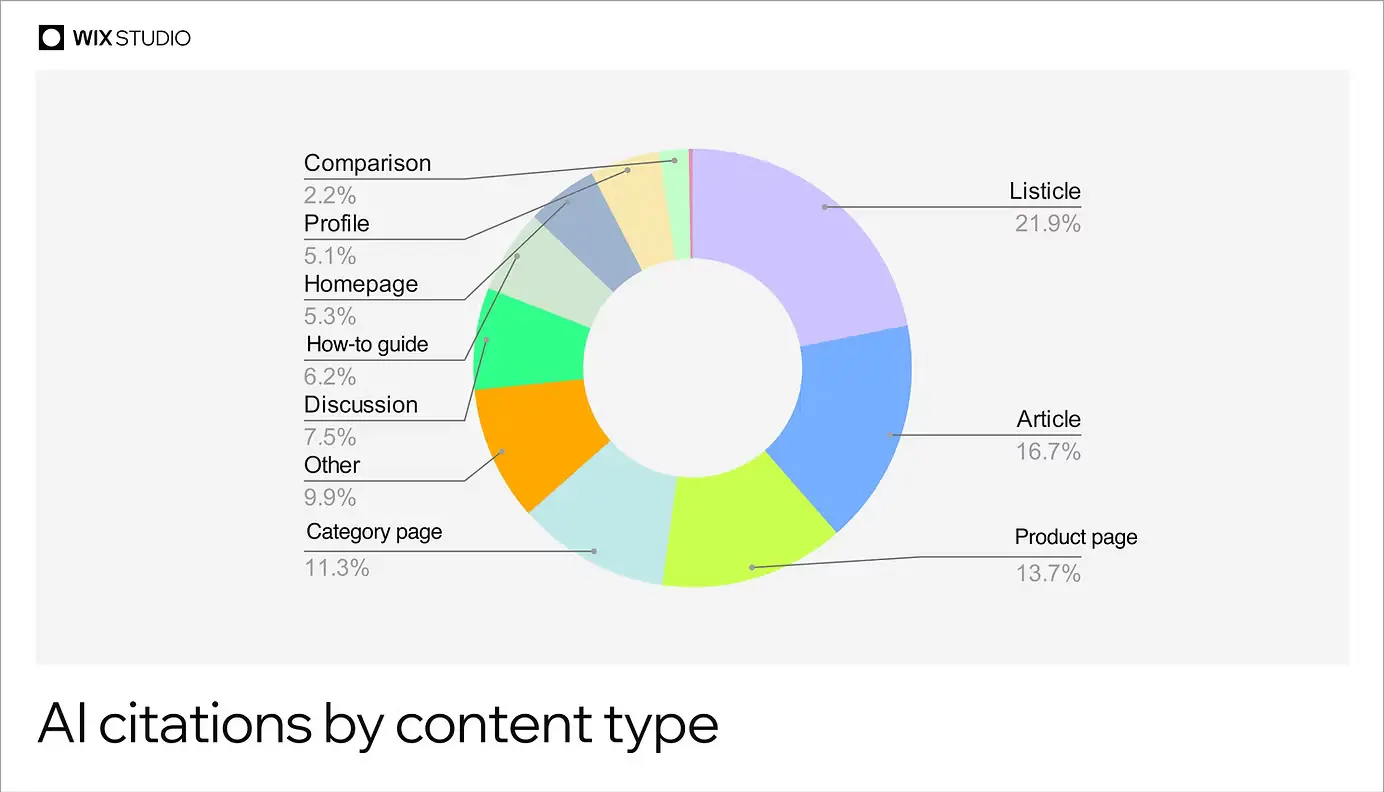
Source: Wix
The idea is easy. But it's important to mention that the blog posts on your own website, where you put yourself as the number one suggestion, don't work as well.
Self-promotional listicles account for only 19% of citations. The other 81% comes from listicles posted on other quality websites.
4. Get More External Mentions (Including Unlinked)
While AI search is growing, most brands don't show up there at all. And of those that do, only 30% stay visible across back-to-back answers.
If you also struggle with LLM brand visibility, one of the best things you can do is to get more external mentions to improve your brand authority.
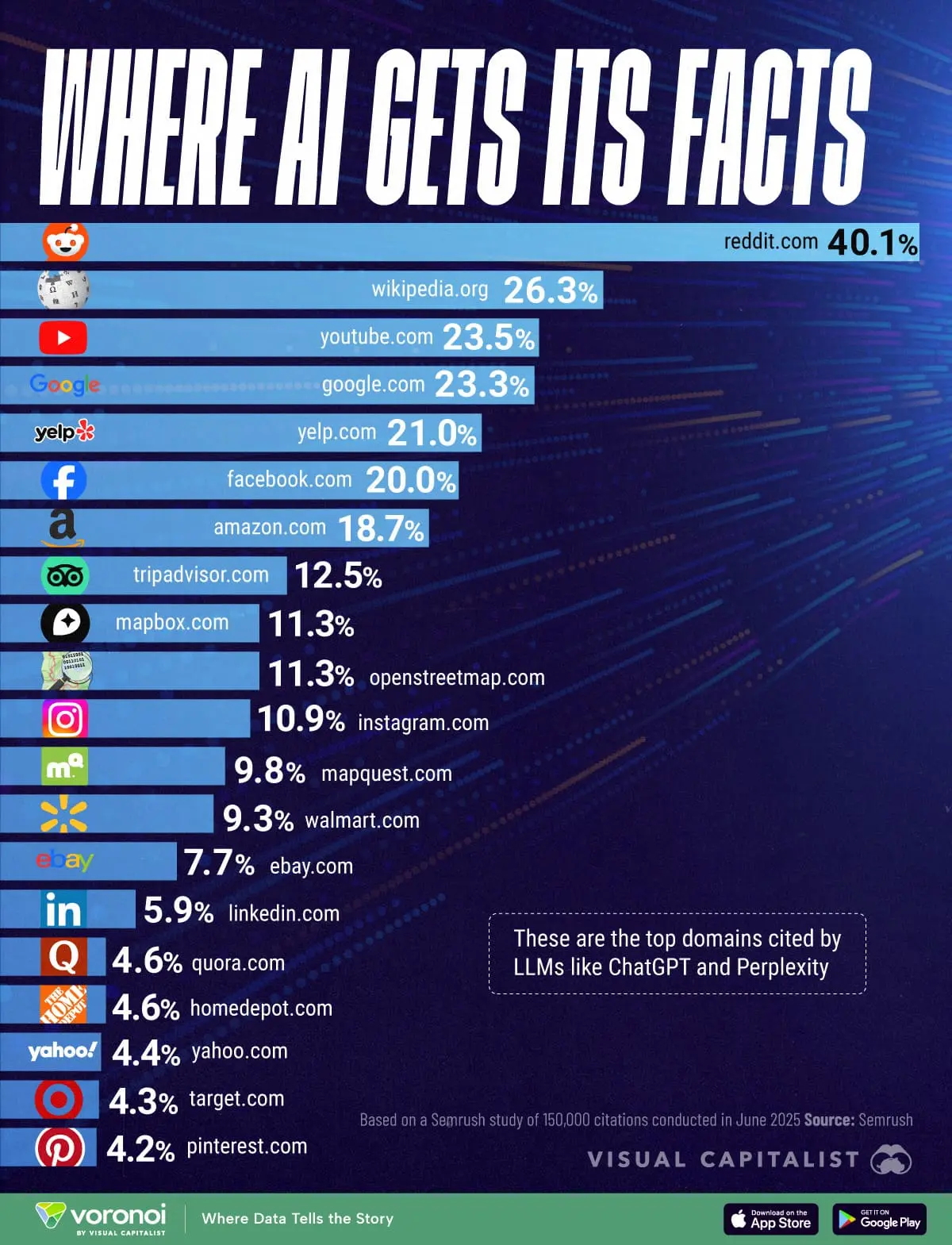
The ideal combination is to keep getting quality backlinks and add other natural mentions (linked or unlinked). Ideally, try to prioritize the most cited websites in AI search:
• Reddit, Quora, and other relevant forums
• YouTube (video-based answers are especially popular in AI Overviews)
• Review platforms like G2 or Trustradius, especially for B2B
• Socials, especially Facebook and LinkedIn
• Yelp and Tripadvisor for local businesses
Source: Visual Capitalist
5. Do Marketing Campaigns That Attract Attention
People can only search for you when they remember you in the first place. It's obvious. Yet, we tend to forget about it. That's why your marketing has to remind everyone about your brand at least from time to time.
Often, businesses ignore this because it seems like you can only attract positive attention with a huge marketing budget.
But that's not the point.
The campaigns that actually make people care don't require fancy locations and professional gear. Humans care when they feel something.
Here is, for example, Burger King's campaign where they "fired" their King mascot.
Burger King® | There's a New King and It's You.
What made this campaign work is that the chain openly admitted its flaws, said they've heard the feedback, and that they're trying to change.
This, of course, generated lots of positive responses from people:
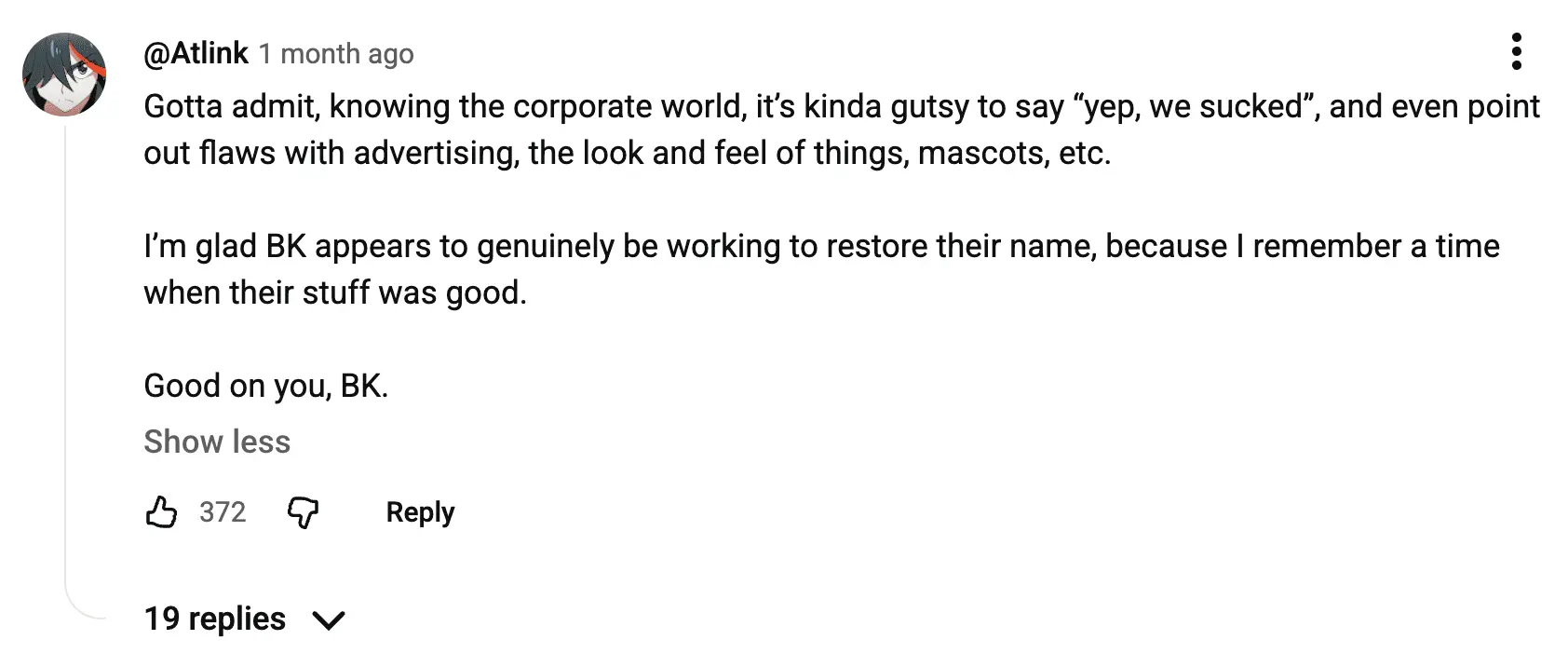
As for their brand search volume, it also spiked after the campaign:
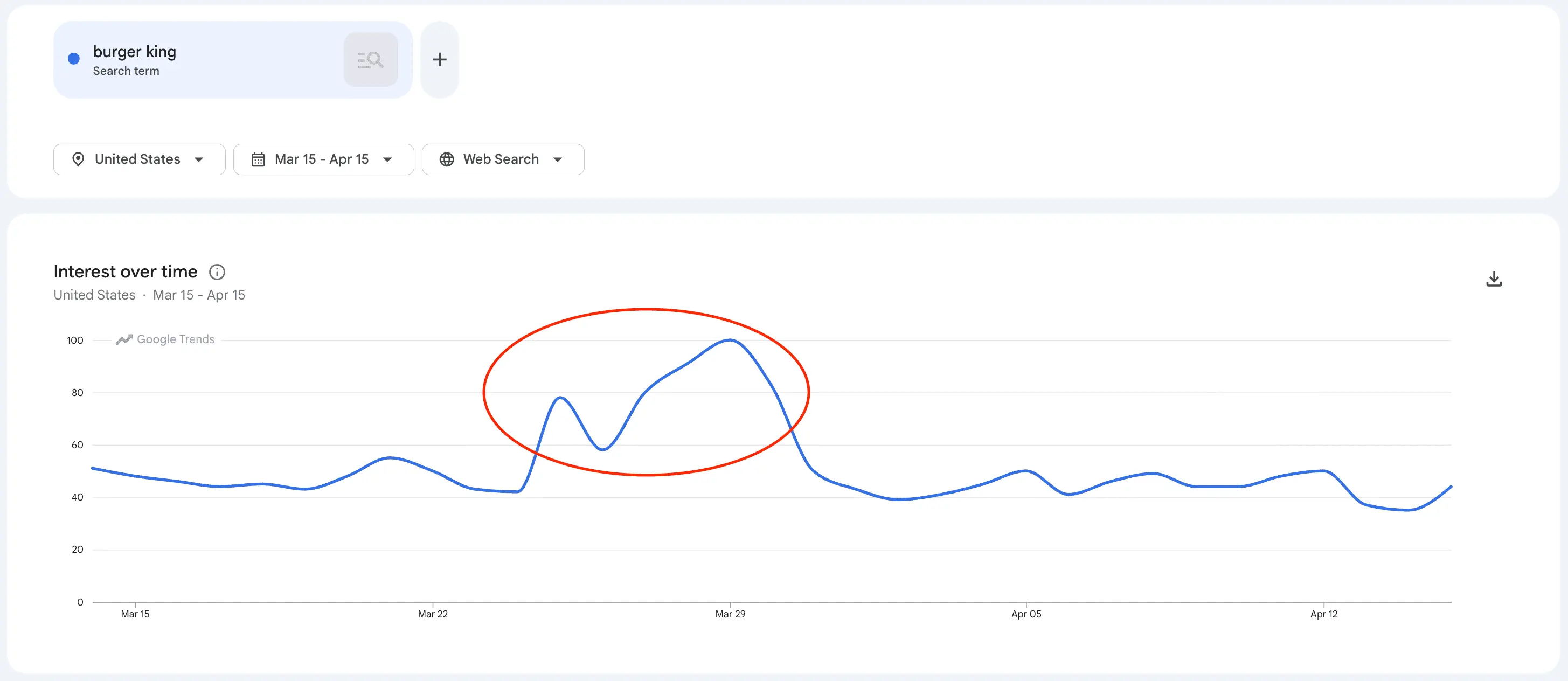
Source: Google Trends
6. Post Relevant Content in Your Niche
No matter what industry we look at, some brands come to mind right away. How did they create this strong connection?
It took a lot of time and brand authority building.
They've been sharing their knowledge and expertise for years. And at some point, the compounding effect did its work.
So, yes, it's a slow process. But posting relevant, expert content is also one of the best ways to show that you have expertise.
To make it work, the topics you cover have to be closely related to the service/product you offer. Once you define those, you can also optimize your posts better by:
1. Finding relevant keywords and building topic clusters to cover your subjects more deeply.
2. Optimizing your content for both traditional and AI search.
3. Refreshing your content regularly to make sure it stays relevant.
This won't increase your share of search overnight. But it will definitely help you become a stronger voice in your industry.
And this is the point at which branded searches grow much faster.
7. Optimize Your Website for Search Engines and LLMs
If you want to perform well in search, you have to take care of your SEO and AI optimization.
While most websites do at least something for traditional SEO, LLM search optimization is still quite a mystery to many.
So, these are some of the things that can help you change that:
1. Keep your structure clean: A wall of text is hard to digest for both your readers and the algorithms. So, do everything to make your copy easy to scan. Use clear headings (from H1 to H4), add bullet points and numbered lists, etc.
2. Use schema markup: It's structured data (a code) that helps AI systems better understand what your content is about.
3. Give direct answers: Start responding to major questions right away. If your H2 says "What is…", your first sentence should give a definition. All the other details can wait.
4. Add FAQs and summaries: While these aren't mandatory, they're good to have because they can increase your search visibility in ChatGPT and other LLMs.
5. Take care of your traditional SEO: While this might sound counterintuitive, your website won't do well in AI search if it isn't secure or takes ages to load. So, basic optimization is a must.
Final Words
Share of search isn't just a brand awareness measurement. It shows you whether people care about your business at all.
Essentially, by tracking it, you can see how your brand visibility is doing.
Still, while SoS is important, it's just a single metric. That's why it can't show you a full picture. So, the best approach is to use it as one piece of the puzzle that shows you how "healthy" your brand actually is.
Frequently Asked Questions
How to calculate the share of search?
Divide your branded search volume by the total branded searches across your category or niche. Then, multiply it by 100 to get the percentage.
What is an example of the share of search?
Imagine your business gets 20,000 branded searches. Your competitor A gets 35,500, competitor B gets 12,500, and competitor C gets 22,000 branded searches.
Then, your share of search will be: 20,000 ÷ (20,000 + 35,500 + 12,500 + 22,000) × 100 = 22%.
What is the difference between SoS and SoV?
Share of search (SoS) refers to how often users search for your business instead of the competition.
Share of voice (SoV) refers to how often your business is being mentioned or noticed in general across a particular channel (social media, ads, forums, reviews, etc.).
So, SoS is about searching for your brand, while SoV is about noticing and mentioning it.
Check Your Brand Visibility
Enter a keyword or domain
Discover More SEO Tools
Backlink Cheсker
Backlinks checking for any site. Increase the power of your backlink profile
API for SEO
Search big data and get results using SEO API
Competitor Website Analytics
Complete analysis of competitors' websites for SEO and PPC
Keyword Rank Checker
Google Keyword Rankings Checker - gain valuable insights into your website's search engine rankings
Recommended posts
Cases, life hacks, researches, and useful articles
Don’t you have time to follow the news? No worries! Our editor will choose articles that will definitely help you with your work. Join our cozy community :)
By clicking the button, you agree to our privacy policy.