SEO vs. GEO vs. AEO vs. LLMO: How AI is Changing Search Optimization

Contents
The Rise of AI Search: Navigating the New Alphabet
- What is Generative Engine Optimization?
- Answer Engine Optimization (AEO): Voice Search & Direct Answers
- Large Language Model Optimization (LLMO): Chatbots and AI Models
Comparing SEO, GEO, AEO, and LLMO
Strategic Tactics: How To Measure Traditional and AI Search Visibility
The widespread adoption of artificial intelligence has changed how search works, resulting in a range of new prompts. Search engine optimization was the original main concept to know, but phrases like GEO, AEO, and LLMO have also become important for understanding how modern search works.
Keep reading to learn all about these key search terms, why they exist, and how they relate to one another.
The Rise of AI Search: Navigating the New Alphabet
Traditional search engine optimization strategies involved keyword placement, earning relevant backlinks, improved site structure, improved content quality, and faster page speed. Updated SEO strategies involve crawlability and indexability, search intent, information architecture, content usefulness, user experience (UX), and measurement and conversion outcomes.
These characteristics encourage algorithms to rank webpages higher in search engine results pages (SERPs) for relevant user queries. Strong organic visibility can support AI Overview visibility, but rankings and AI citations do not map one-to-one.
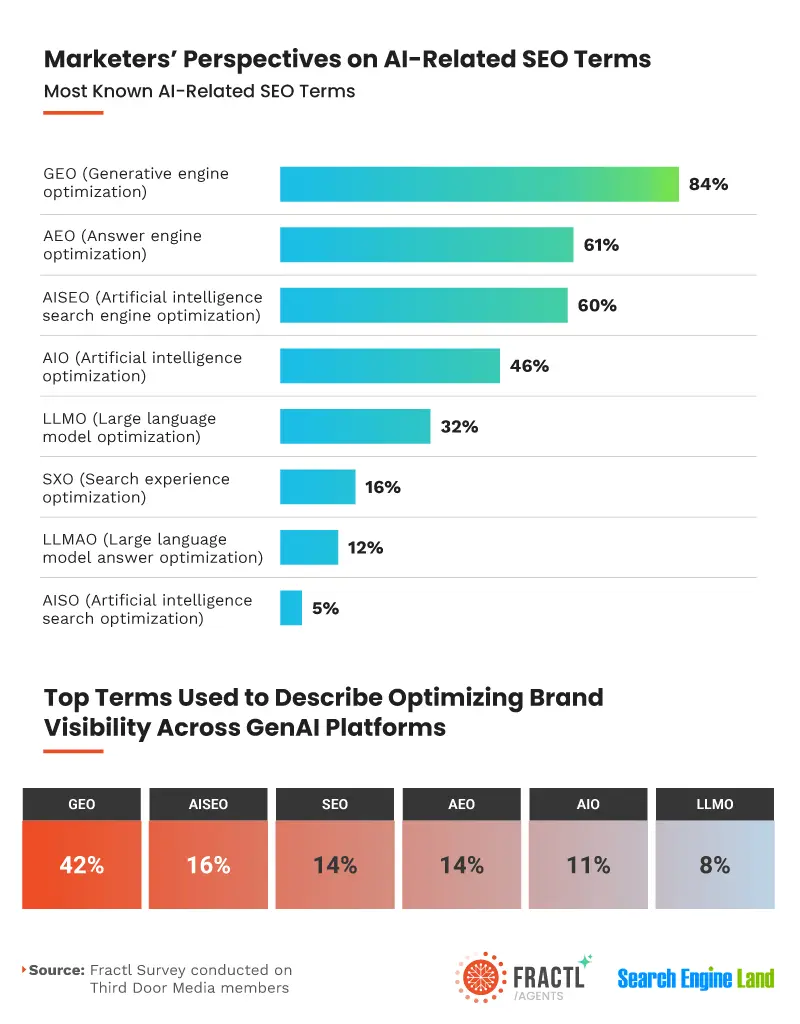
The rapid advancement of search-based technologies has resulted in an influx of new search terms. The majority of these new phrases are related to the increasing integration of AI and the new strategies that businesses are using to maintain visibility in search and generated answers.
Increasingly, AI-integrated tools help users find answers without clicking any of the links offered. AI tools like ChatGPT and Claude, as well as AI assistants like Siri and Alexa, are also becoming more common ways for users to find answers.
These new terms and their nonstandard boundaries have also led to the misuse or conflation of some terms. For example, some users might say “AI-friendly SEO tactics” when they are really referring to GEO tactics or AEO tactics.
However, it is important to remember that SEO, GEO, AEO, and LLMO are all distinct but overlapping concepts and that the industry does not use GEO, AEO, and LLMO consistently. The definitions below provide a practical framework rather than a universal taxonomy. Knowing how to properly use each term will help make sense of this AI-assisted search environment.
What is Generative Engine Optimization?
Generative engine optimization (GEO) is the process of optimizing content to improve a website’s visibility in AI-powered search engine results. The focus of GEO is to create comprehensive and citation-worthy content, build brand authority, and otherwise send trust signals to AI-powered algorithms.
In Seer Interactive’s Q3 2025 analysis, queries where a brand was cited in an AI Overview were associated with 35% higher organic CTR and 91% higher paid CTR than queries where it was not cited.
Answer Engine Optimization (AEO): Voice Search & Direct Answers
Answer engine optimization is the process of structuring content so that it provides direct, succinct answers to user queries. Common AEO tactics include answering questions clearly, using descriptive headings, and adding structured data where it supports an eligible search feature.
The primary objective of answer engine optimization is to have content included in featured snippets and knowledge panels as well as to be included in answers given by AI voice assistants like Siri or Alexa.
Large Language Model Optimization (LLMO): Chatbots and AI Models
Large language model optimization is the process of improving how accurately and consistently a brand, product, or source is represented in LLM-generated responses by models like Claude, Gemini, and ChatGPT.
In practice, measurable work usually focuses on retrieval visibility, entity consistency, authoritative third-party coverage, and response monitoring — not direct control over model training data.
Comparing SEO, GEO, AEO, and LLMO
Although SEO, GEO, AEO, and LLMO can be easily defined by themselves, it can also be helpful to compare them to one another to better understand how each functions.
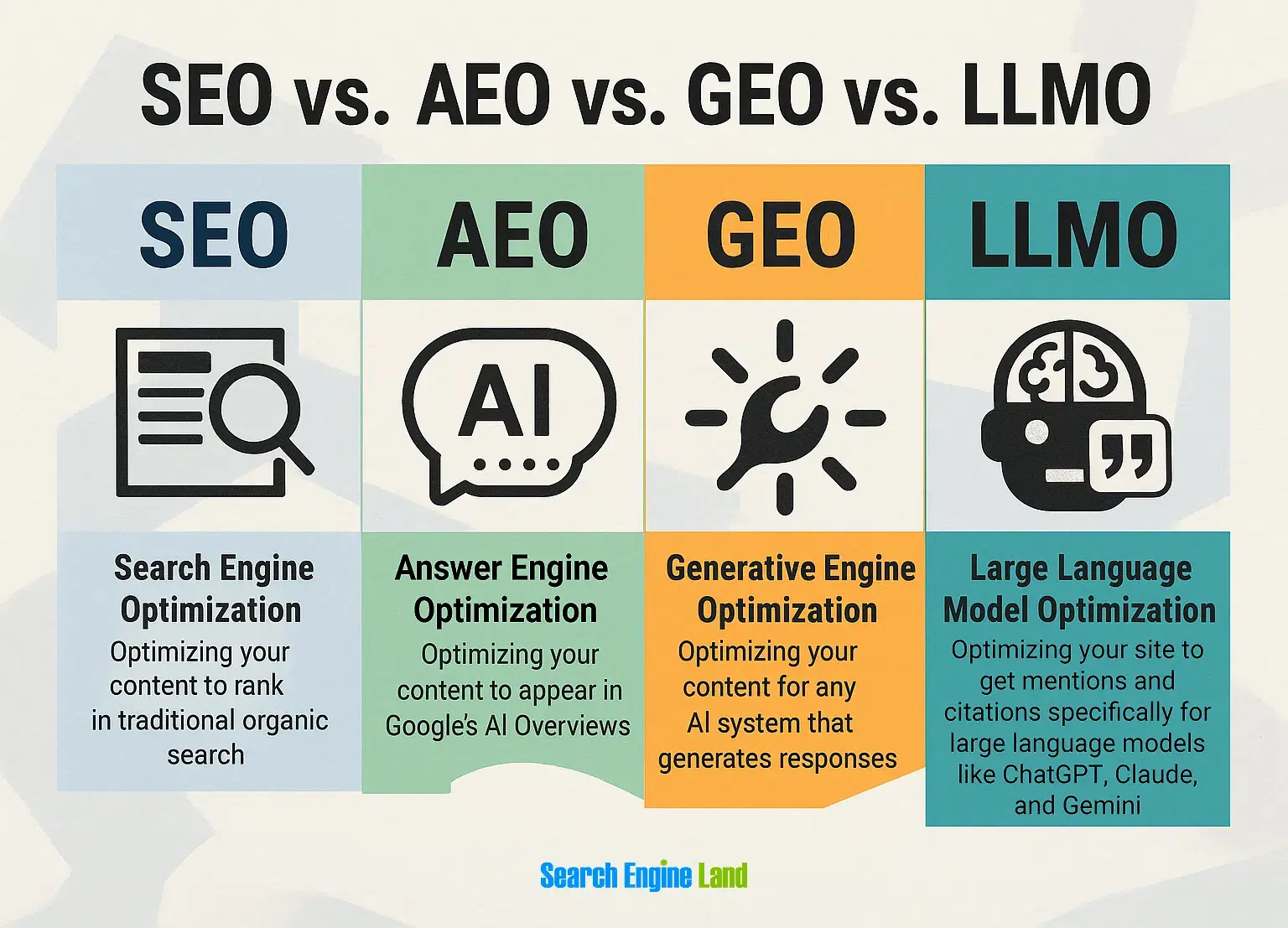
Although each concept differs in many ways, there are also a few key areas of overlap that site managers should be aware of.
Optimization Targets: Where Your Content Needs to Appear
- SEO targets traditional search engines like Google and Bing
- GEO targets AI search and answer platforms, including Google AI Overviews, ChatGPT Search, Microsoft Copilot, and Perplexity.
- LLMO targets large language models, which overlap with the AI systems that GEO targets.
- AEO targets featured snippets displayed in search results while also targeting voice assistants like Siri and Alexa.
Strategic Tactics: How To Measure Traditional and AI Search Visibility
Every type of optimization related to search also requires a specific set of tactics. Classic SEO techniques also support visibility in generative search. GEO adds an emphasis on evidence, entity clarity, authoritative coverage, and AI visibility measurement.
AEO tactics focus on providing clear answers to common questions, making content concise and digestible, and structuring webpages in a way that is easy to read by both humans and machines. All of these characteristics overlap with both SEO and GEO techniques. Lastly, LLMO encompasses many of the previously mentioned tactics by focusing on accurate and comprehensive content in addition to cross-platform trust signals.
KPI & Success Metrics: Tracking Traditional Rank vs. LLM Share of Voice
SEO metrics center on organic rankings with keyword position, click-through rates (CTR), impressions, and ranking distribution as some key metrics.
GEO success metrics center on AI citations, with key metrics including brand mentions, citation frequency, and source attribution.
AEO success naturally centers on being included in snippets and voice answers, with key metrics including impressions, and share of answer.
Share of answer is a metric that measures how much of the actual experience a brand owns within AI-generated responses, summaries, and answer boxes. It requires a weighted scoring model based on whether the brand is the primary answer, a secondary mention, or one item on a list.
Serpstat’s AIO Score
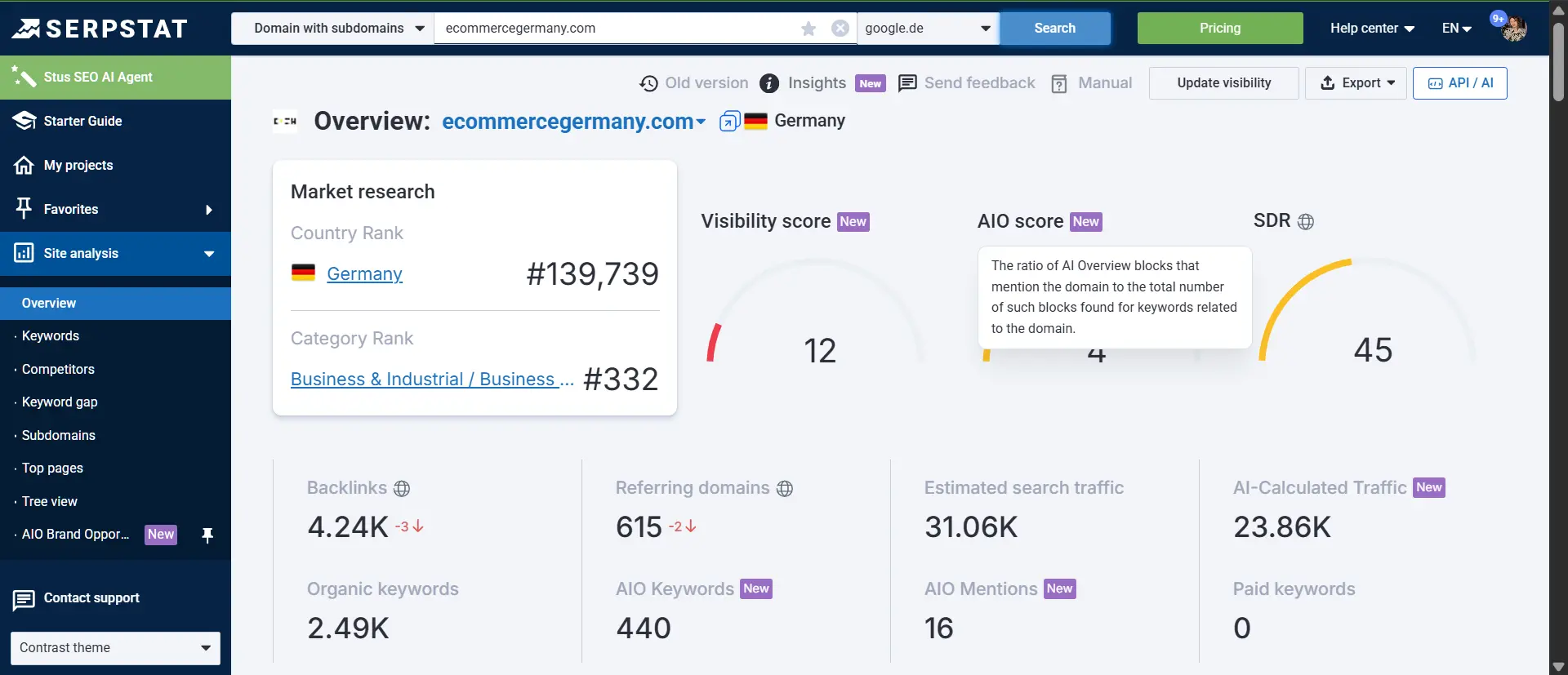
LLMO success centers on accurate and consistent brand representation in large language models. Key related metrics include entity coverage, prompt recall rate, and brand accuracy in model outputs.
Prompt recall rate (also “prompt coverage”) is the percentage of tracked, non-branded prompts for which an AI system surfaces a brand without the brand name appearing in the prompt itself.
Entity coverage (also “share of model voice”) is the degree to which a brand and its products or concepts are correctly recognized and consistently represented as distinct entities by search and AI systems.
Sentiment analysis and Brand Accuracy check in LLM Brand Monitor
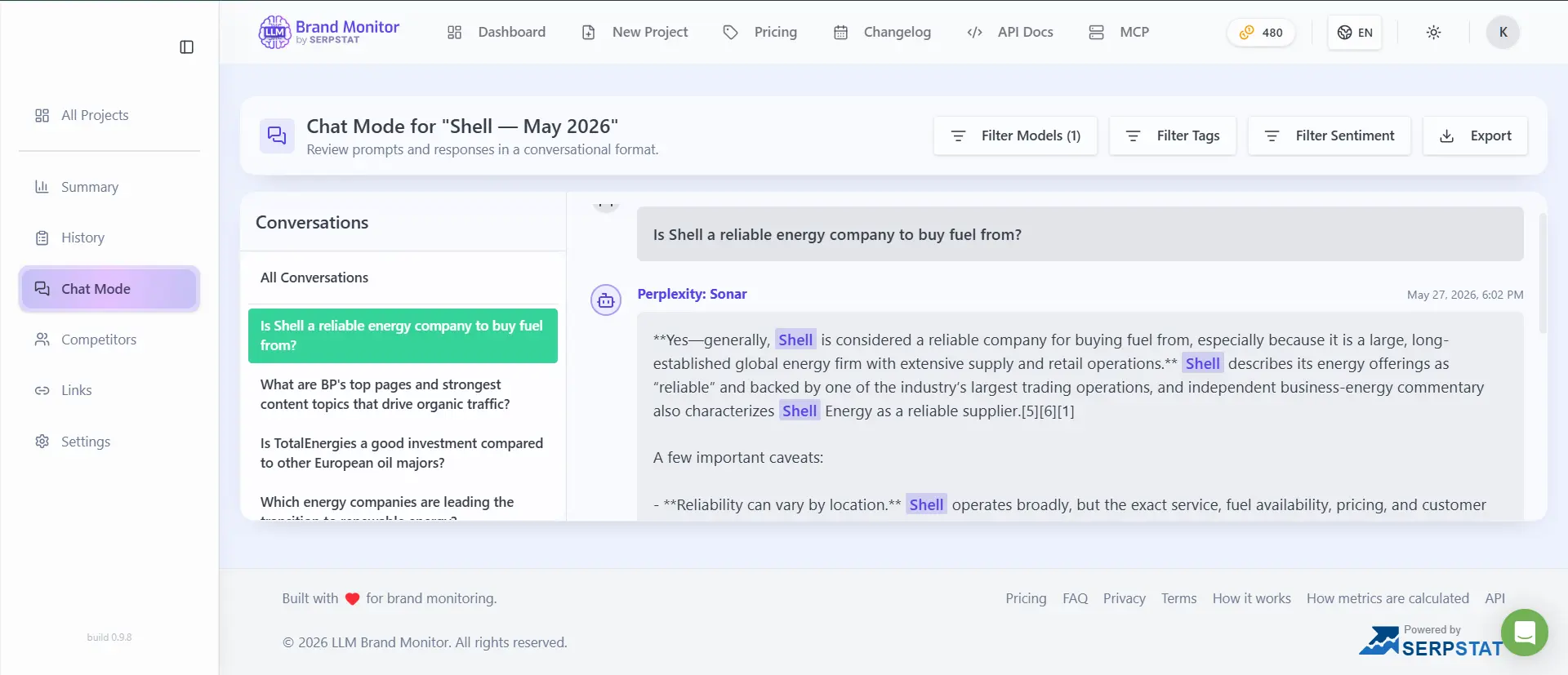
Tracking all of these key metrics across two search paradigms can be difficult to sustain, but Serpstat treats it as one measurable discipline. Serpstat’s Rank Tracker monitors traditional rankings alongside appearances in Google AI Overviews, while LLM Brand Monitor shows how major AI models mention and describe each brand.
How Has AI Changed SEO Strategies?
Across GEO, AEO, and LLMO, there is a major focus on high-quality content, brand authority signals, understanding the intent and context of user queries, and an evolving sense of search optimization.
GEO’s Focus on Quality
The implementation of AI has also led to an industry-wide focus on content quality. Creating large amounts of content with copious keywords and backlinks was enough for initial SEO strategies, but AI search and answer platforms are designed to look for accurate and comprehensive content with backlinks from reputable sources and organic inclusions of keywords. Expertise and experience should be clear parts of AI-friendly content going forward.
An independent February 2026 analysis of 1.2 million ChatGPT search results found that 44.2% of citations came from the first 30% of the analyzed pages content. While this does not establish a universal rule, it supports placing the main answer and strongest evidence early.
AI Search Authority Signals
To be referenced, cited, and used by AI models, brands need to be seen as both authoritative and trustworthy. Google recommends demonstrating experience, expertise, authoritativeness, and trustworthiness, although E-E-A-T is not itself a specific ranking factor.
Backlinking remains an important part of search optimization as an authority signal for search and generative systems selecting which content should be used in answering user queries.
Intent and Context in AI Search
AI systems are designed to focus on user intent and the context of each user query instead of just looking at keyword placement. These emerging technologies seek to understand why each user entered their specific queries. They use methods like query fan-out techniques to break queries into discernible parts and then run multiple related searches simultaneously in order to give the user the most comprehensive answer.
Key Takeaways
AI-powered search has introduced new optimization terms as users discover information through search engines, AI Overviews, answer engines, and large language models.
SEO, GEO, AEO, and LLMO are related but not identical: SEO focuses on visibility in traditional search results, GEO on citations and mentions in AI-generated answers, AEO on direct answers and featured snippets, and LLMO on how brands and content are represented in large language models.
These approaches overlap because they all depend on clear, trustworthy, well-structured content. Strong technical SEO, consistent brand information, authoritative sources, and answer-focused formatting can improve visibility across both traditional and AI-driven search experiences.
FAQs
Generative engine optimization (GEO) is the process of optimizing content and data to improve a website’s visibility in AI-powered search engine results. The objective of GEO is to get your brand cited and referenced repeatedly by platforms like Google AI Overviews, ChatGPT, and Perplexity.
Answer engine optimization (AEO) is the process of structuring content so that it provides direct, succinct answers to user queries. AEO focuses on a clean layout, definition-first content structures, and structural elements like FAQ so readers can quickly find clear answers.
Large language model optimization is the practice of improving how accurately and consistently a brand, product, or source appears in LLM-generated responses in Claude, Gemini, and ChatGPT.
The difference between SEO and GEO is that the former focuses on increased visibility in traditional search engine results, while the latter focuses on increased citations and mentions by AI search and answer platforms. SEO is about getting a webpage ranked highly on search engine results pages (SERPs), while GEO is about being cited in AI-generated answers to user queries.
Check Your Visibility in Search and AI
See where your pages appear in Google AI Overviews with Serpstat
Discover More SEO Tools
Backlink Cheсker
Backlinks checking for any site. Increase the power of your backlink profile
API for SEO
Search big data and get results using SEO API
Competitor Website Analytics
Complete analysis of competitors' websites for SEO and PPC
Keyword Rank Checker
Google Keyword Rankings Checker - gain valuable insights into your website's search engine rankings
Recommended posts
Cases, life hacks, researches, and useful articles
Don’t you have time to follow the news? No worries! Our editor will choose articles that will definitely help you with your work. Join our cozy community :)
By clicking the button, you agree to our privacy policy.