AI Overviews and Organic Traffic: How Serpstat’s New Model Measures the Impact

Serpstat has updated its organic traffic estimation algorithm. The updated model considers a site's organic rankings, whether an AI Overview appears in the search results, and whether the domain is cited in it. As a result, the projected traffic in Serpstat may change even if the actual number of visits to the site remains the same.
We'll explain how the new model works, what factors influence the calculation, and where to view the updated metrics.
What Has Changed in Serpstat's Traffic Estimates
Before AI Overviews became an integral part of Google's search, we calculated traffic using a domain's position in the search results, the search volume of keywords the domain ranks for, and the CTR (click-through rate) of positions in the top 20 of organic search results.
AI Overview significantly reduces click-through rates even for sites in the top position. However, a new component — citations in AI Overview — helps: a cited domain may receive more clicks than an uncited domain at the same ranking position. Nevertheless, citations alone cannot fully compensate for the loss of clicks in organic search results.
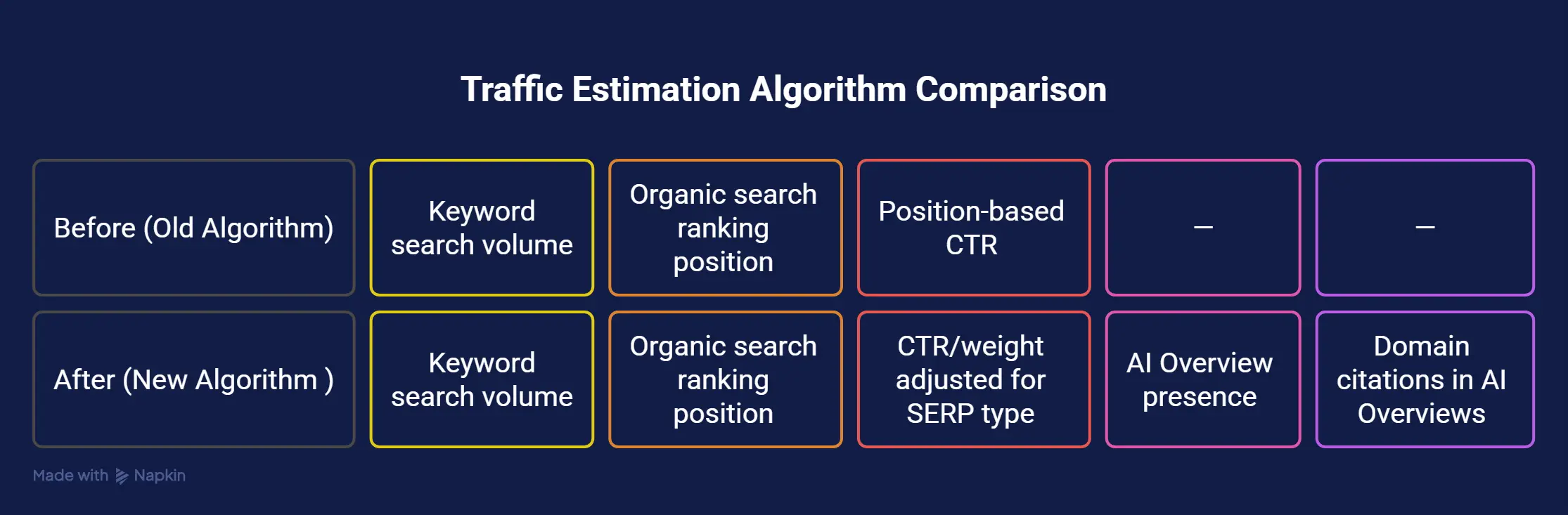
With this in mind, we've updated the traffic estimation algorithm in Serpstat, and the metric's value will change for most domains. We've now expanded the data used to estimate traffic.
Serpstat is gradually rolling out AI-Calculated Traffic across its search databases, prioritizing larger domains.
Why AI Overview Changes Organic Traffic Estimates
In early 2025, the AI Overview began appearing in search results, but it was present on only a few percent of search engine results pages (SERPs). Even then, we decided that we needed a new metric that would be adapted to these changes in search results. Using machine learning, we developed a new algorithm for calculating traffic that takes the presence of AI Overview into account.
Over the following year, AI Overviews became more common: in the U.S., according to Google's own data, it now appears in about half of all queries. Globally, the share of such SERPs averages around 20–30%, depending on the region and query type.
As AI Overviews have become more common in search results, we've gradually expanded our database with this data. We've also started collecting data on the content of the AI Overview. Now we have data on which domains are cited within this block and which are not. This data has enabled us to significantly improve our traffic calculation algorithm to account for this new type of search result.
We examined when exactly it appeared in different regions and how frequently AI Overviews appear in search results:
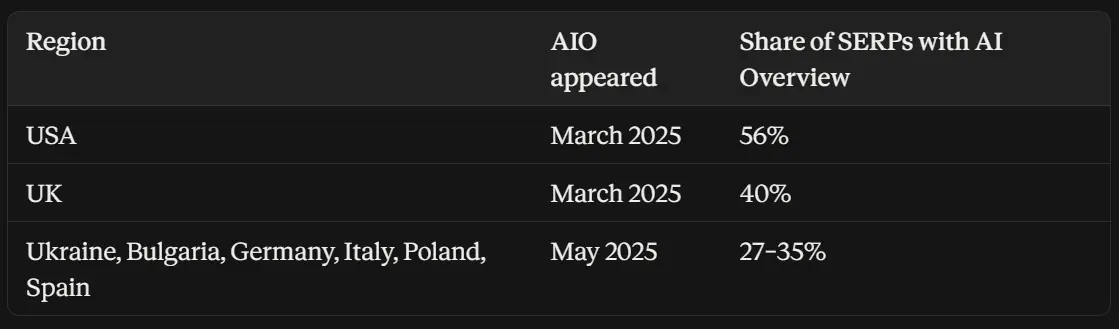
In total, we've already collected AIO data for over 180 regions.
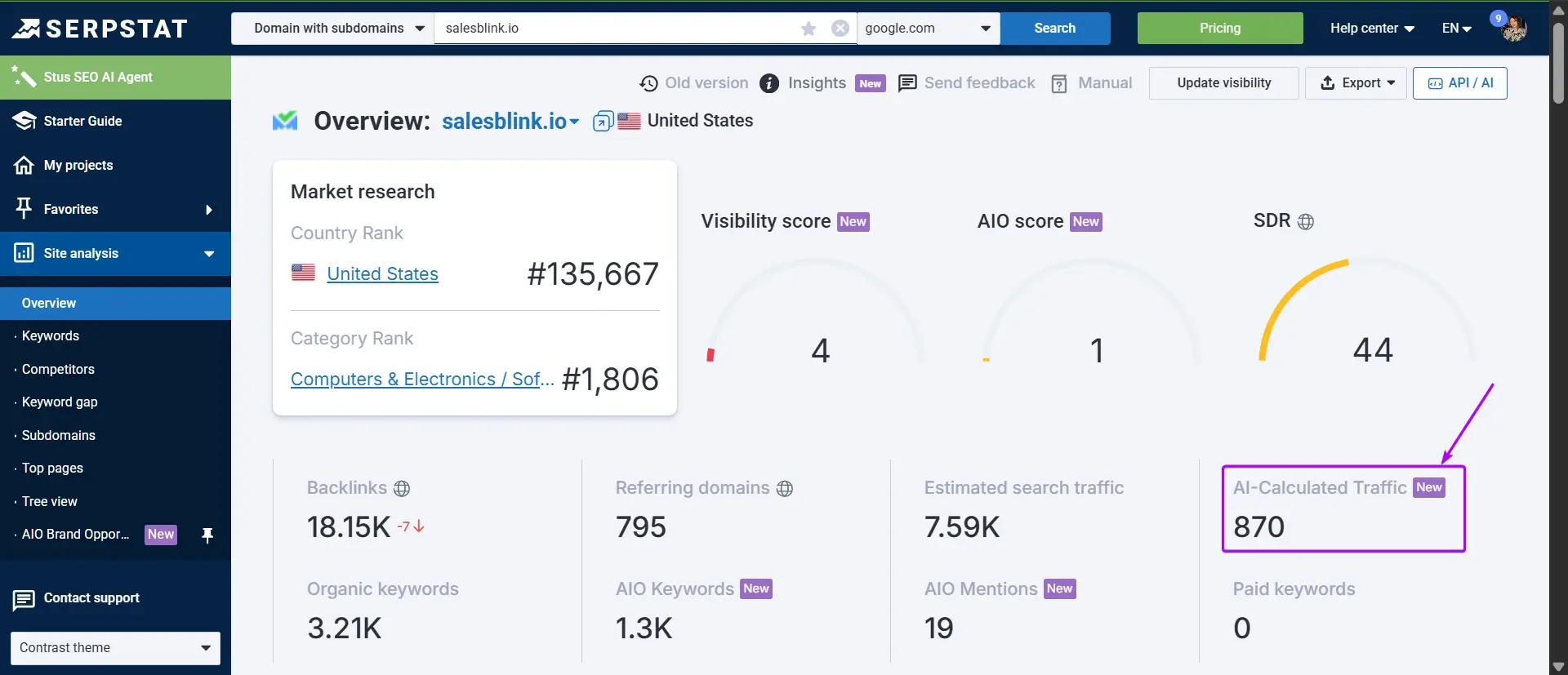
Where can you find the new metric? In the Domain Summary Report ("AI-Calculated Traffic" alongside the classic "Estimated Search Traffic").
How Serpstat's New Traffic Model Works
In the new algorithm, we also take into account a domain's position in the top 20 of organic search results, but the weight of this position has been reduced.
- Whether the AI Overview appears in the search results
- Whether the domain is among the top 20 organic results
- Whether the domain is cited in the AI Overview

When AI Overviews are Absent
When an AI Overview Appears
Example: for the same keyword and organic ranking position, the new model assigns a higher traffic weighting to domains cited in an AI Overview than to domains that aren't cited.
What This Means for SEO Professionals
The most favorable scenario for organic traffic is to rank in the top 20 search results without an AI Overview. If an AI Overview is present, being cited in it gives the domain an advantage over other organic search results.
With more comprehensive data, the model now more accurately distinguishes domains based on whether they are cited in the AI Overview, rather than just on its mere presence in the search results. We've started tracking AI-calculated traffic, and new metrics will begin appearing in the Domain Summary Report. For many domains, the updated estimates will differ from the previous values. The new model is designed to better reflect how AI Overviews affect organic search traffic.
What to keep in mind when analyzing:
- A change in projected traffic does not necessarily mean a change in actual traffic. After the algorithm update, metrics in Serpstat may increase or decrease, but it's important to distinguish between Serpstat's traffic estimates and actual web analytics data.
- For identical positions in the top 20, the model applies a higher weighting to domains cited in AI Overview than to those that are not cited. Therefore, when analyzing search visibility, it's important to consider not only organic rankings but also the domain's presence in AI Overview.
- We've added a marker to the graph showing when we began using the new algorithm. The old, classic traffic calculation algorithm remains available for viewing in the report and will not change.
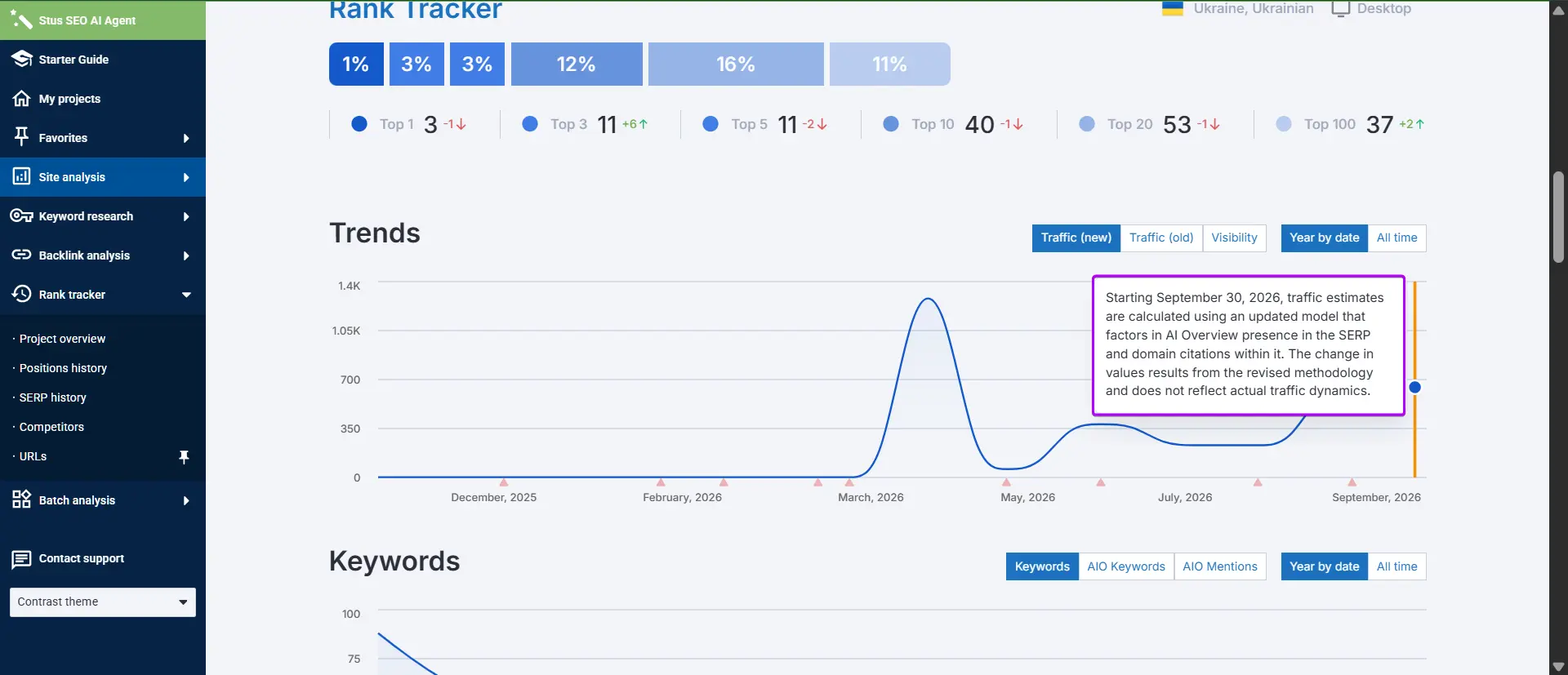
As of September 30, 2026, traffic is estimated based on an updated model that takes into account the presence of the AI Overview in search results and whether the domain is cited within it. A change in values is determined by the calculation methodology and does not reflect actual traffic trends.
We'll continue monitoring AI Overview prevalence, domain citation rates, and new SERP features to refine our traffic estimates as search behavior evolves.
FAQ
Serpstat has updated its traffic estimation algorithm. It now takes into account the presence of AI Overview in search results and domain citation within that block.
The overall CTR drops by approximately 38%, and some queries become "zero-click." Serpstat calculates it this way: if a domain ranks in the top 20 of organic search results and is cited in the AI Overview, the model applies a higher coefficient to it when calculating traffic. It's nearly twice as high as the coefficient for a domain in the same position that isn't cited in the AI Overview.
The new "AI-calculated traffic" metric is available in the Domain Summary. Data is updated gradually, so the new estimate may not yet be displayed for some domains.
Yes. Serpstat retains the classic traffic calculation algorithm and its metrics in the report. The graph also includes a marker indicating when the new model was first used, making it easier to analyze changes.
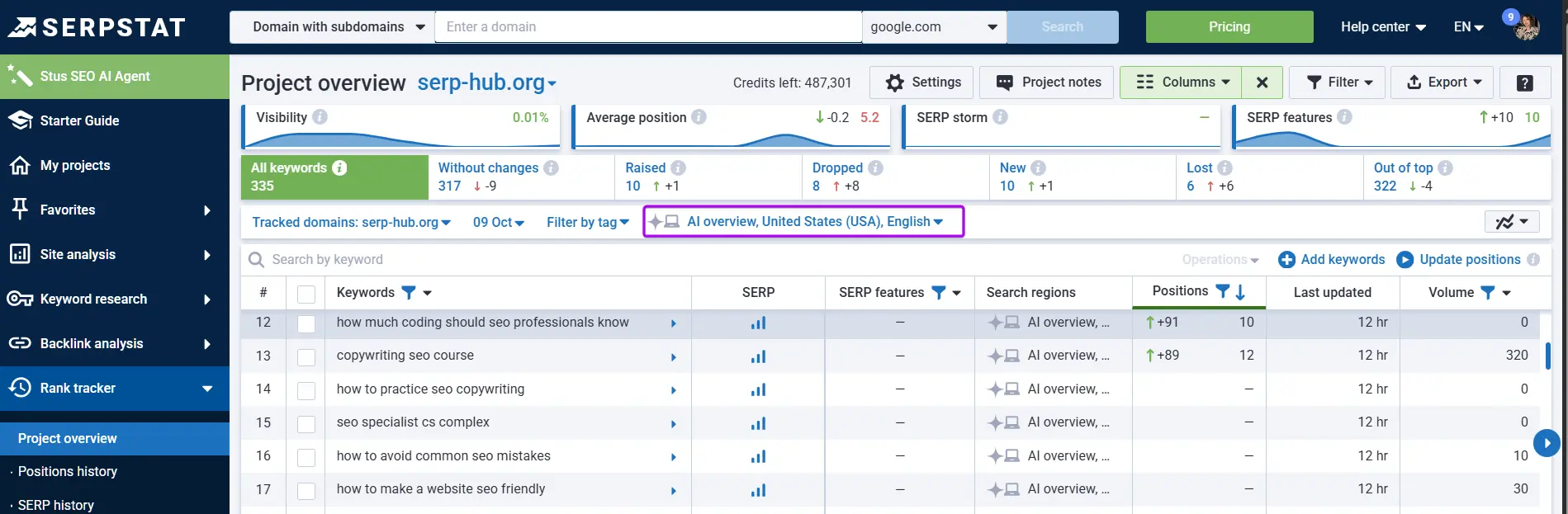
You can track a site's appearance in AI Overview using the "AIO Mentions" metric in the Serpstat Summary Report, as well as the "Rank Tracking" tool. This allows you to monitor a domain's visibility not only in organic search results but also in Google's AI answers.
Check Your AI-Calculated Traffic
Recommended posts
Cases, life hacks, researches, and useful articles
Don’t you have time to follow the news? No worries! Our editor will choose articles that will definitely help you with your work. Join our cozy community :)
By clicking the button, you agree to our privacy policy.